
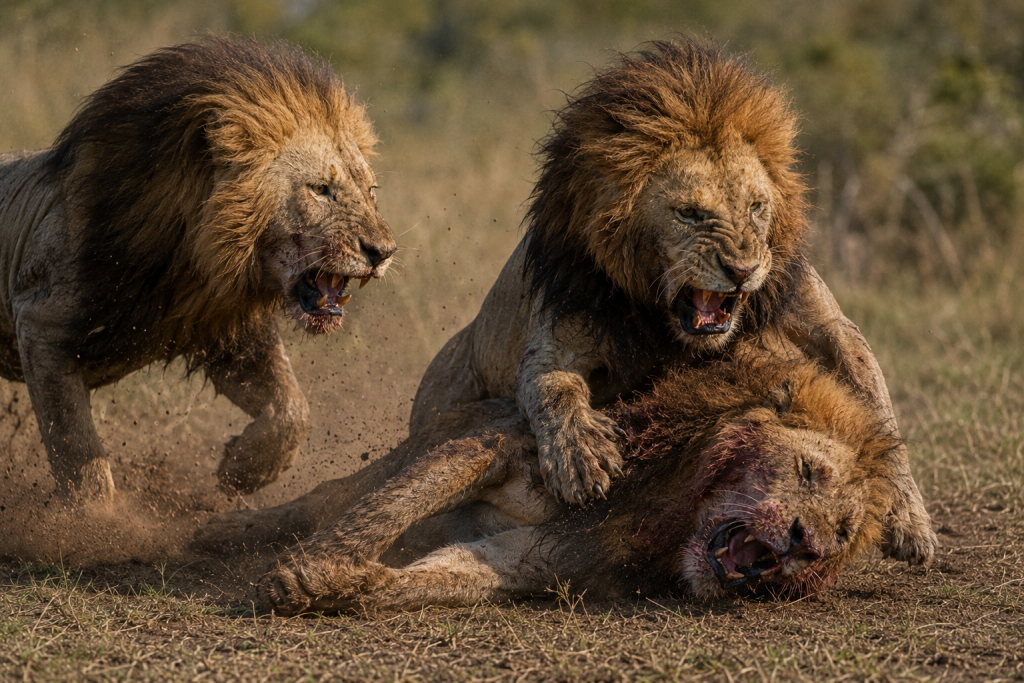
The dramatic struggle between rival lion coalitions reveals the brutal realities of power, survival, and succession in the wild.
The African savannah is a landscape of breathtaking beauty, but beneath its golden grass lies a constant struggle for survival. For predators at the top of the food chain, life is not only about hunting prey. It is also about defending territory, protecting offspring, and maintaining dominance over rivals.
Few animals embody this harsh reality more than the lion.
On one unforgettable day, two nomadic male lions known as the Mbiri brothers returned to the territory they had once ruled. Months earlier, they had been defeated and driven away by a rival coalition known as the Avoca brothers. Forced into exile, the Mbiri males had wandered the savannah in search of food and survival.
But former kings rarely forget their kingdom.
When the two coalitions met again, the encounter erupted into a violent confrontation that would leave one lion dead and another seriously injured. The battle offered a rare glimpse into one of nature’s most intense rivalries and highlighted the extraordinary pressures shaping lion society.
Life and Conflict on the African Savannah
The African savannah is one of the world’s most competitive ecosystems. Seasonal rainfall patterns cause herbivore herds to move continuously across vast landscapes in search of fresh grass and water. Predators must follow these migrations if they hope to survive.
For lions, territory is everything.
A pride’s territory contains access to prey, water sources, resting sites, and, most importantly, females. Losing control of territory can mean losing reproductive opportunities and ultimately losing the chance to pass on genes to future generations.
Competition becomes especially fierce in regions where several lion coalitions occupy overlapping ranges. Boundaries are rarely permanent. Stronger males frequently challenge resident coalitions, and successful takeovers can completely reshape the social structure of a pride.
It was under these conditions that the Mbiri and Avoca coalitions found themselves locked in a deadly struggle.
The Power of Lion Coalitions
Male Lions: Guardians and Warriors
Unlike lionesses, which are primarily responsible for hunting and raising cubs, male lions play a different role within pride society.
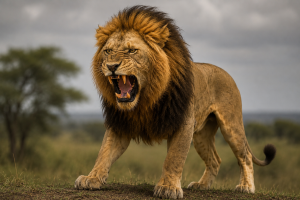
Adult males defend territory, protect pride members from external threats, and compete with rival males for breeding rights. Their massive size, muscular build, and powerful canine teeth make them formidable opponents.
A mature male lion may weigh more than 200 kilograms and possesses tremendous strength. However, physical power alone is often not enough to secure dominance.
Most successful males form coalitions, usually consisting of brothers or closely related individuals. These alliances allow males to cooperate when defending territory or challenging rivals.
Coalition living dramatically increases a lion’s chances of controlling a pride for extended periods.
The Mbiri and Avoca Brothers
The confrontation described by wildlife observers involved two separate coalitions.
The Mbiri brothers had once controlled the territory. Following their defeat by the Avoca brothers, they became nomads, wandering without a permanent home.
Nomadic life is exceptionally difficult for male lions. Without access to pride females or stable hunting grounds, displaced males face constant risks from starvation, injuries, and attacks by other predators or rival lions.
Yet nomadic males often remain dangerous.
If they survive long enough, they may eventually return to challenge resident males and reclaim lost territory.
Why Do Male Lions Fight?
The conflict between the Mbiri and Avoca coalitions was not random aggression. It was driven by powerful evolutionary pressures.
Competition for Territory
Territory provides access to food, water, and secure resting areas. Males that control productive territories enjoy significant survival advantages.
Because high-quality territories are limited, competition is inevitable.
When resident males weaken or become outnumbered, challengers may attempt to seize control.
Reproductive Opportunities
Perhaps the most important reason male lions fight is reproduction.
Within lion society, dominant males gain access to breeding females. Losing territory often means losing nearly all reproductive opportunities.
From an evolutionary perspective, controlling a pride ensures that a male’s genes are passed to future generations.
This makes territorial battles among males extraordinarily intense.
Coalition Strength Determines Success
Lion coalitions operate much like military alliances.
Two or three cooperating males can successfully challenge larger opponents, defend territory more effectively, and maintain dominance for longer periods.
However, coalition success depends heavily on teamwork.
During the confrontation between the Mbiri and Avoca males, observers reported that one Avoca lion eventually withdrew from the fight. This left his brother isolated against two opponents.
The numerical disadvantage quickly proved decisive.
The Final Battle
Before the encounter, the Mbiri brothers had fed on the carcass of a buffalo, ensuring they entered the confrontation well nourished and physically prepared.
As they moved through their former territory, they encountered the Avoca coalition.
Neither side retreated.
Deep roars echoed across the savannah as the rival males approached one another. The confrontation escalated rapidly into a violent struggle involving immense strength, speed, and aggression.
Dust filled the air as the males clashed.
Powerful forelimbs struck repeatedly while jaws searched for vulnerable areas around the head, neck, and shoulders. Such battles can inflict devastating injuries within seconds.
The turning point came when one Avoca male disengaged from the fight.
Suddenly, the remaining lion faced two experienced opponents alone.
Although he fought desperately, the odds were overwhelming. Eventually, the exhausted male was subdued and later died from his injuries.
Even the victorious Mbiri coalition did not escape unharmed. One brother reportedly suffered severe injuries around the mouth, demonstrating the enormous risks involved in territorial combat.
In the world of lions, there are rarely true winners.
Lessons from Nature’s Battlefield
The confrontation between these rival coalitions reveals several important lessons about survival in the natural world.
Power Is Never Permanent
Dominance on the savannah is temporary.
Even successful coalitions eventually face stronger challengers. Every ruling male will one day be tested.
Cooperation Increases Survival
Coalitions provide one of the greatest advantages available to male lions. Cooperation improves hunting opportunities, territorial defense, and reproductive success.
The battle clearly demonstrated how numerical superiority can determine outcomes.
Survival Requires Adaptation
After losing their territory, the Mbiri brothers adapted to life as nomads. Their ability to survive exile ultimately allowed them to challenge for power once again.
Adaptability remains one of nature’s most valuable survival traits.
Evolution Favors Persistence
Male lions endure extraordinary hardship because reproductive success depends on securing and defending territory. Those able to survive setbacks may eventually gain another opportunity to reproduce.
The struggle between the Mbiri and Avoca coalitions illustrates the unforgiving reality of life for male lions. These battles are not acts of cruelty but expressions of powerful evolutionary forces shaping one of Africa’s most iconic predators.
On the African savannah, kingship is never guaranteed.
Territories change hands, alliances rise and fall, and former rulers may one day return to challenge those who replaced them.
For lions, survival is not simply about strength. It is about endurance, cooperation, and the relentless determination to reclaim what was once lost.
