
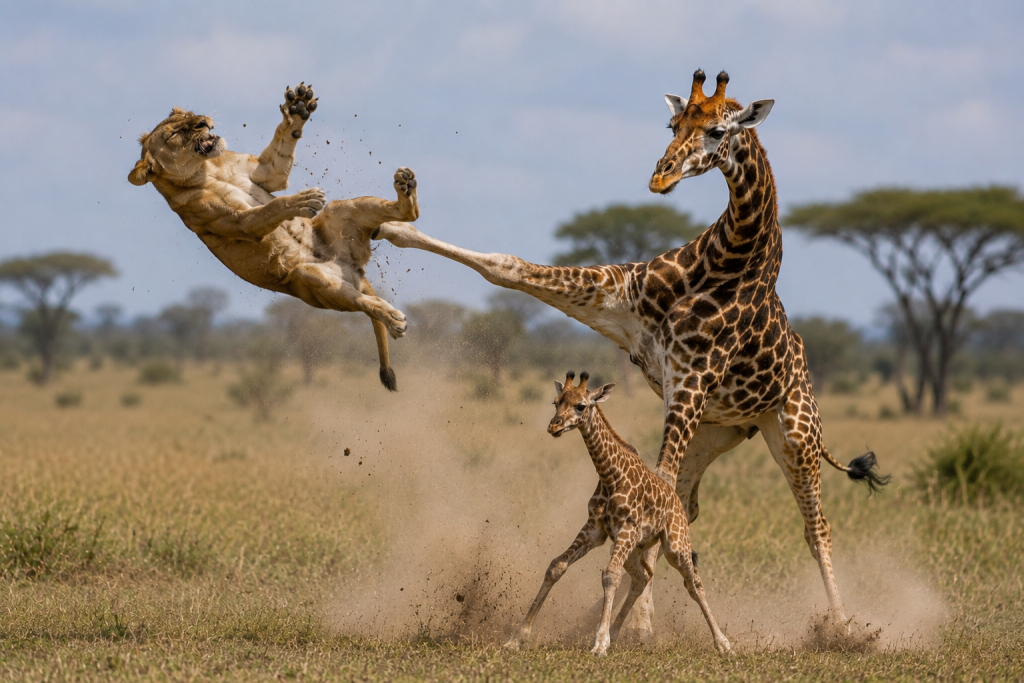
A lion attacking an adult giraffe risks broken ribs or worse from a single kick. Yet on the African savannah, lions still choose to hunt giraffes, and mothers still choose to fight lions to protect their young. Both decisions carry real danger.
So what actually happens when a lioness has a giraffe calf cornered, and the mother turns back?
This article breaks down the biology and risk calculation behind a real lion vs giraffe encounter, one that shows why raw strength rarely settles a fight on its own.
Survival on the African Savannah
Across the dry grasslands, a lioness had separated a young giraffe from its mother and was closing the distance fast. The calf ran awkwardly, its long legs still lacking the coordination of an adult. For a few critical moments, it was alone, and the hunt looked all but finished. Then the mother stopped running and turned back toward the predator.
Giraffe calves face serious danger from their first days of life. Lions, leopards, and hyenas constantly search the savannah for young, inexperienced, or isolated prey, and a calf separated from its mother is exactly that. Despite standing taller than most adult humans within hours of birth, a young giraffe lacks the strength and experience to defend itself, which is precisely what makes it a target worth the risk.
Meet the Giraffe: A Gentle Giant With a Deadly Defense
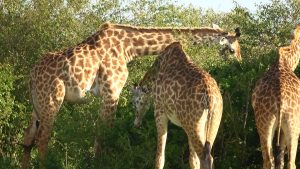
The Masai Giraffe (Giraffa tippelskirchi) is one of Africa’s most recognizable herbivores. Adult males can stand over 18 feet tall, and their height offers more than a feeding advantage, it lets them spot approaching predators from a distance across open terrain. Their legs, capable of reaching roughly 35 miles per hour over short distances, double as a formidable weapon. An adult giraffe can kick forward, backward, or sideways with enough force to seriously injure or kill a lion, which is exactly why lions generally avoid healthy adults and instead target the young, sick, or isolated. Mothers also stay closely attached to their calves during these vulnerable early months, teaching them to read the landscape and recognize danger before it closes in.
Meet the Lion: A Master of Opportunity
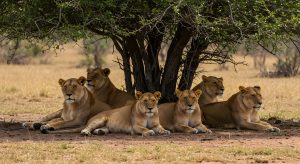
The Lion (Panthera leo) is Africa’s largest social cat, and its greatest advantage is strategy rather than raw power alone. Lionesses often hunt cooperatively, using positioning and coordination to separate vulnerable animals from a herd or a protective adult, but even hunting alone, a lioness carefully evaluates risk before committing to an attack, weighing the energy gained from a kill against the cost of injury. A giraffe calf offers a meaningful meal without the danger an adult presents, provided the mother can be kept away long enough to finish the hunt.
Why Lions Target Young Giraffes
Every hunt is, in effect, an energy calculation. A successful chase delivers a meal; a failed one wastes energy, and a serious injury can cost far more, it can end the ability to hunt at all. A giraffe calf offers a favorable version of that calculation, real reward without the danger a full-grown adult presents. The safest approach is straightforward: isolate the calf and end the hunt before the mother can respond. On this day, the lioness comes close to pulling it off.
The Hunt: The Calf Is Cut Off
That is the calculation this lioness made. She stayed hidden until the distance was short, then charged. The giraffes fled together at first, but the calf began losing ground, and the lioness shifted her focus entirely onto the young animal, closing the gap between mother and calf. Cut off and unable to escape, the calf had nowhere left to run. Then the mother turned.
The Counterattack: The Mother Giraffe Strikes Back
Charging directly at the lioness, several hundred kilograms of adult giraffe forced an immediate choice: keep pursuing the calf or respond to the threat now closing in. The lioness hesitated, and that hesitation was enough. The mother reached her calf and placed herself between it and the predator, meeting each attempted approach with a charge or a kick. Eventually, the risk outweighed the reward, and the lioness retreated. The calf survived, and the hunter left without a meal.
Why a Giraffe Kick Is So Dangerous
The giraffe’s defense works through simple biomechanics. Long legs create exceptional reach, letting the animal strike before a predator gets close enough to grab hold, while its hooves concentrate significant force into a small point of impact. This is what makes the lion-giraffe relationship unusual among African predator-prey pairs: the lion can kill the giraffe, but the giraffe can just as easily kill the lion. Terrain, numbers, age, and timing all shape which outcome occurs, and neither side holds a guaranteed advantage.
Lessons From Nature’s Battlefield
This encounter offers several clear lessons about survival on the savannah. Vulnerability can shift in seconds, an isolated calf was easy prey, while the same calf shielded by an aggressive adult was not. Maternal defense is one of the strongest behavioral drives in nature, and the mother accepted genuine risk to protect her offspring’s chance at reproductive success. The lioness, meanwhile, did not fail from a lack of courage. She withdrew because a serious injury could have cost her weeks of hunting ability, and recognizing that threshold is itself a survival skill. Size mattered here, but so did timing, positioning, and willingness to fight.
Not every hunt is meant to end in a kill, at least not from a purely statistical view. Lions fail far more often than they succeed, and most predator-prey encounters end this way, with the hunter walking away empty-handed rather than the dramatic outcome documentaries tend to favor. A single failed attempt costs a lioness time and energy, but rarely more, which is exactly why the risk of a giraffe’s kick changes the equation so sharply.
Conservation Perspective
Giraffes and lions each play essential roles in African ecosystems. Giraffe browsing helps shape woodland structure and vegetation patterns, while lions regulate herbivore populations and support broader ecological balance. Both species face mounting pressure from habitat loss, fragmentation, and human-wildlife conflict, and protecting large, connected landscapes remains essential so predators retain room to hunt and herbivores retain access to food, water, and safe migration routes. Giraffe numbers across Africa have declined by an estimated 40 percent over the past three decades, leading the IUCN to classify the species as Vulnerable, while African lion populations fell by roughly 42 percent over a comparable 21-year period, according to IUCN Red List data. The ancient relationship between lion and giraffe depends entirely on functioning habitat, and neither species can be protected in isolation from the other.
The lioness had done nearly everything right. She had identified a vulnerable target, separated it from its mother, and closed the distance until the hunt appeared all but over. Then the mother turned back, transforming a one-sided chase into a confrontation where a single kick could end badly for the predator. The calf survived not because it was faster or stronger, but because its mother returned at the exact moment it mattered. On the African savannah, strength takes many forms: sometimes speed, sometimes a well-placed kick, and sometimes simply the choice to turn and fight when retreat would have been easier.
