
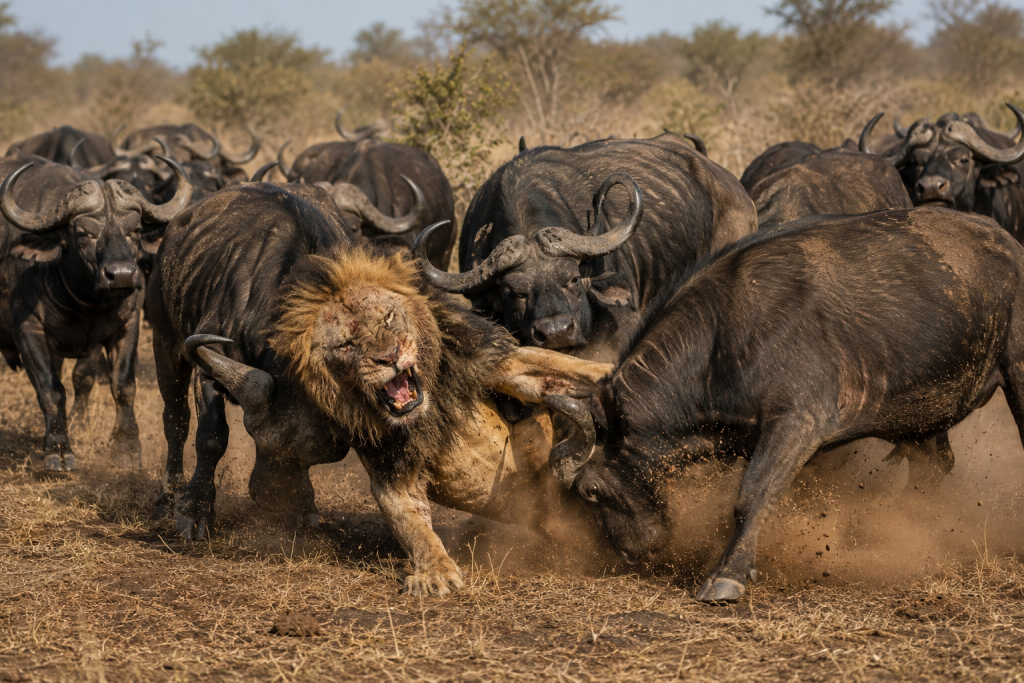
A single buffalo can feed an entire lion pride for days. That same buffalo, backed by a herd of hundreds, can turn the hunters into the hunted within seconds. Both outcomes are possible in the same encounter, decided by little more than which side reacts first.
So what happens when a lion pride commits to attacking a buffalo herd, and the herd fights back?
In South Africa’s Sabi Sands region, that question played out in real time, and the answer nearly cost one male lion his life. This article breaks down the biology and risk calculation behind a genuine lion vs buffalo confrontation, and what it reveals about power that can shift in an instant.
A Hunt in the South African Bush
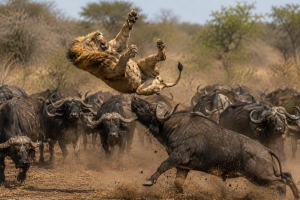
The confrontation unfolded in South Africa’s Sabi Sands region, a landscape known for its density of large predators and prey, where lions share territory with leopards, hyenas, wild dogs, and enormous buffalo herds. A pride had been tracking one such herd, watching for a weak point; a single small animal would not feed the whole group, but one buffalo could sustain it for days. Eventually, one buffalo fell behind and was cornered. The lions closed in, and for a moment the hunt looked all but decided. Then the cornered buffalo called out, and the herd turned to answer. Hundreds of buffalo charged back toward the lions. Most of the pride escaped in time, but one older male, already slowed by a previous injury, was not fast enough. He found himself surrounded.
The African Lion: A Predator Built for Teamwork
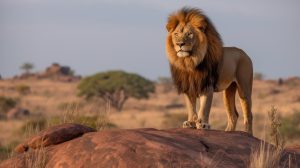
The Lion (Panthera leo) is Africa’s only truly social big cat, and that structure is what makes hunting buffalo possible at all. A single lion attacking a healthy adult buffalo faces enormous risk, but multiple lions attacking from different angles can divide the animal’s attention and gradually wear it down. Lionesses typically carry out this cooperative hunting, though males join in when the reward, several hundred kilograms of meat, justifies the danger. The real challenge is rarely killing a buffalo; it is separating one from the herd’s protection.
The African Buffalo: Prey That Fights Back
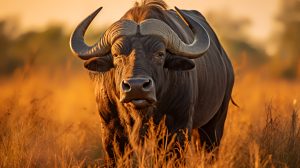
The African Buffalo (Syncerus caffer) is built to make that separation costly. Adult males can weigh more than 700 kilograms and carry heavy, curved horns capable of seriously injuring a predator. But a buffalo’s greatest defense is not its own body, it is the herd around it. Large herds can number in the hundreds, and when one member is threatened, others frequently respond by gathering, surrounding the threat, or charging directly at it. Unlike prey species that rely almost entirely on flight, buffalo are equally capable of turning defense into attack.
Why Lions and Buffalo Clash
This dynamic sets up an evolutionary standoff. Lions rely on stealth, coordination, and picking off isolated individuals. Buffalo rely on numbers, aggression, and a willingness to counterattack collectively. When those strategies collide, the outcome can reverse within seconds, exactly what happened here.
The Counterattack: Hunter Becomes the Hunted
As the herd turned back, the trapped lion, an older male known to researchers as Dark Maned Avoca, searched for an escape route with buffalo closing in from every direction. His prior injury limited his mobility, and as he tried to reach nearby vegetation, the buffalo followed. One animal struck him with its horns, lifting him off the ground. Before he could recover, more buffalo pressed in, hooves striking the ground around him. For roughly fifteen minutes, an unusually long span for an animal under direct attack, he fought simply to stay alive, until his calls drew the rest of the pride back. The other lions helped drive the herd away, and the attack ended. Dark Maned Avoca survived, badly injured but alive.
Why the Buffalo Fought So Hard
The buffalo’s aggression here is not cruelty; it is a calculated survival strategy. A predator left unchallenged near the herd remains a continuing threat to calves and vulnerable adults, so driving it off, even at real risk to individual buffalo, reduces future danger to the group. Numbers are what make this possible: a single buffalo facing several lions is vulnerable, but hundreds of buffalo facing one isolated lion represent overwhelming force.
How the Lion Survived
Dark Maned Avoca’s survival was remarkable given his existing injury. Adult male lions carry considerable physical strength, dense bone structure, and heavy muscle mass that can absorb impacts a smaller animal could not. Even while surrounded, small shifts in position let him turn some direct hits into glancing blows. But the decisive factor was the return of the pride: once the other lions pushed back against the herd, the pressure eased just enough for him to find an opening, a reminder that his survival owed as much to social living as to individual toughness.
Lessons From Nature’s Battlefield
This encounter offers several lessons about power on the savannah. Dominance can reverse in an instant, the same lions that selected and cornered their target were, minutes later, fighting to save one of their own. Raw strength has limits: even one of Africa’s most capable predators can be overwhelmed by sheer numbers. Social bonds mattered on both sides, the herd returned for a threatened member, and the pride returned for a trapped one, meaning this was really a contest between two social groups rather than a single predator against a single prey animal. And prior injury never fully disappears from the equation: a situation a healthy lion might have avoided became life-threatening for one already carrying a physical limitation.
Conservation Perspective
Lions and buffalo are both essential to the ecosystems they share. Lion predation helps regulate herbivore populations and prevents overgrazing, while buffalo herds shape vegetation through grazing and provide the prey base that sustains lion populations. Both species face growing pressure from habitat loss and fragmentation, and protecting large, connected landscapes like Sabi Sands remains essential to sustaining this ecological balance.
Lions are often described as kings of the savannah, but the events that unfolded that morning are a reminder that dominance in the wild is never permanent. The pride began the hunt in full control, selecting a target and closing in with practiced coordination. Within minutes, one of their own was fighting simply to survive. He did, but only because of the same social bonds that make lions effective hunters in the first place. On the African savannah, power does not always belong to the strongest individual. Sometimes, it belongs to the herd that decides to turn around.
