
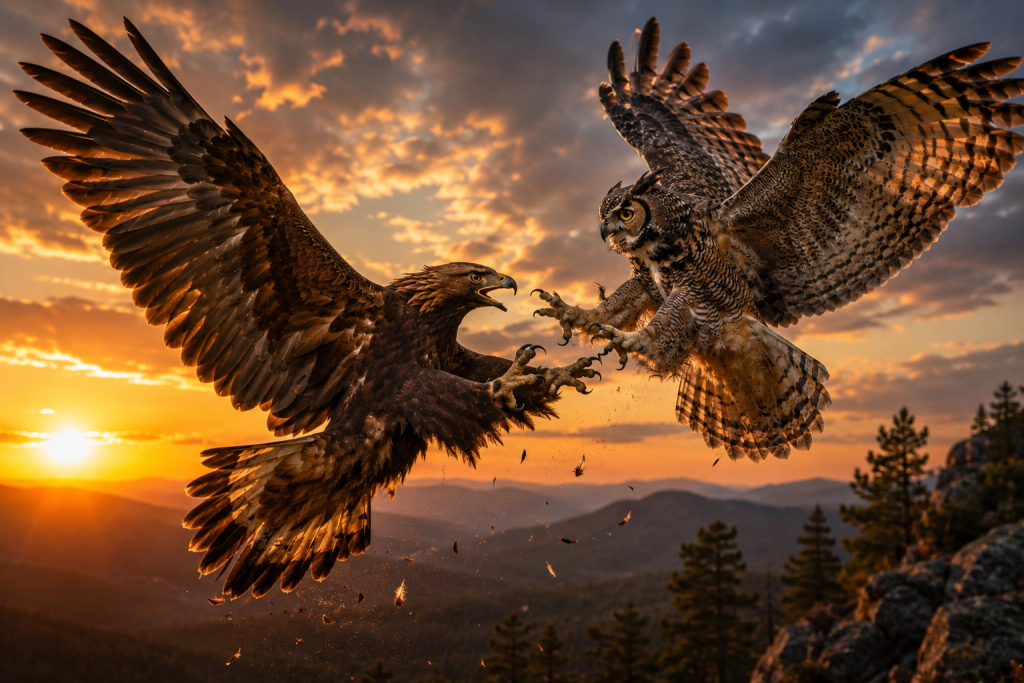
Two of North America’s most formidable birds of prey almost never meet. One rules the open sky by day. The other owns the darkness by night. Their hunting grounds overlap across mountain valleys, grasslands, and forest edges, yet their schedules keep them apart, one shift ending as the other begins.
But what happens on the rare evening when a Golden Eagle refuses to leave before a Great Horned Owl is ready to hunt?
At dusk, in a stand of pine trees overlooking an open valley, that question found an answer. This article breaks down the biology, ecology, and survival strategy behind a genuine Golden Eagle vs Great Horned Owl encounter, and what it reveals about power, timing, and the hidden rules that govern conflict in the wild.
A Clash Between Two Different Worlds
A Golden Eagle had spent the afternoon hunting across open grassland and was feeding on a rabbit atop a rocky ledge as the light began to fade. Nearby, inside a stand of pines, a pair of enormous yellow eyes had already opened. A Great Horned Owl was watching, and its nest was close by.
Two apex predators, two different worlds, one shrinking window of overlapping time.
Golden Eagles and Great Horned Owls occupy some of the same landscapes across North America, including mountain terrain, deserts, grasslands, and forest edges. Direct encounters remain uncommon, largely because the two species are active at different times of day.
The Golden Eagle: Power Built for Daylight
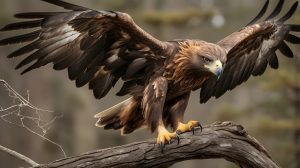
The Golden Eagle (Aquila chrysaetos) is a diurnal hunter built for altitude and speed. Adult females can weigh over 13 pounds and carry wingspans exceeding seven feet, using rising air currents to soar above vast territories while scanning the ground for movement. Once prey is spotted, the eagle descends fast, striking with talons capable of crushing bone. Rabbits, ground squirrels, prairie dogs, and other birds make up much of its diet, and under the right conditions it can take prey considerably larger than itself.
The Great Horned Owl: Precision Built for Darkness
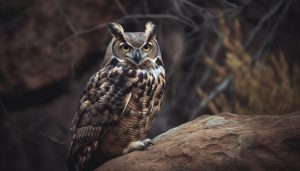
The Great Horned Owl (Bubo virginianus) is built for an entirely different battlefield. Specialized flight feathers break up turbulence and nearly eliminate the sound of its wingbeats, allowing it to approach prey undetected. Paired with exceptional low-light vision and acute hearing, this makes the owl one of the most efficient nocturnal predators in the Americas. It hunts rabbits, rodents, birds, and reptiles, and it defends nesting territory with notable aggression.
Why Two Apex Predators Would Ever Fight
Normally, this division of labor between day and night reduces competition between the species. But at dusk, their schedules briefly overlap. The eagle has not yet returned to roost. The owl has already begun to hunt. If a nest, a kill, or contested territory sits at the intersection, conflict becomes possible.
Wild animals generally avoid unnecessary combat, since injury can mean starvation or death even for an apex predator. But three pressures can override that caution: defense of a nesting site, competition over a fresh kill, and territorial intrusion. In this encounter, all three converged, an eagle feeding within sight of an active owl nest, at exactly the hour when the owl’s advantages were strongest.
The Encounter at Dusk
As the light continued to fade, the owl left its perch. Flying low between the trees, it approached from behind, its wings producing almost no warning. At the last moment, the eagle sensed movement, turned, and met the strike with its own talons raised.
What followed was brief. In open sky and daylight, the Golden Eagle has few equals, but the setting had already shifted in the owl’s favor. Weaving between trunks and branches, the owl used cover and darkness to blunt the eagle’s size advantage, forcing a series of close, disorienting exchanges rather than a clean aerial contest. Unable to gain the room it needed to use its full speed and reach, the eagle broke off and withdrew from the immediate area.
The outcome says less about which bird is stronger than about where and when the contest took place.
Lessons From Nature’s Battlefield
This encounter offers a clear window into how evolution shapes conflict outcomes. Raw strength does not guarantee control of a situation; the Great Horned Owl neutralized much of the eagle’s physical advantage using timing, cover, and low light. Evolution does not produce one perfect predator, it produces specialists. The eagle dominates open, sunlit terrain, while the owl thrives in darkness and clutter. Each is formidable only within the conditions it evolved to exploit.
Territory also proves its worth in moments like this. For the owl, the contested space held a nest, a food source, and its offspring’s survival, reasons enough to risk a direct confrontation with a larger bird. And the eagle’s withdrawal was not a failure. Continuing a fight in low light and confined space, against an opponent built for exactly those conditions, would have carried needless risk. In nature, disengaging at the right moment is often the smarter, safer choice.
Encounters like this one also illustrate a broader pattern common among apex predators worldwide: dominance is rarely absolute, and it is almost always contextual, shaped by habitat, light, and timing rather than size alone.
Conservation Outlook
Beyond the drama of a single encounter, both species play essential ecological roles. Golden Eagles and Great Horned Owls help regulate populations of rabbits, rodents, and other prey, contributing to balance across the ecosystems they share. Great Horned Owls remain widespread and adaptable across the Americas, but Golden Eagles face mounting pressure from habitat loss, collisions, electrocution on power infrastructure, and disturbance near nesting sites. Protecting open landscapes and forest habitat benefits both, even though their paths only rarely cross.
The meeting between a Golden Eagle and a Great Horned Owl is not simply a clash of two powerful birds. It is a brief overlap between two different worlds, one built on speed, vision, and daylight, the other on silence, hearing, and darkness. When their paths cross at dusk, advantage shifts with the fading light. The eagle remains the stronger bird. But as night falls, the battlefield belongs to the owl.
