
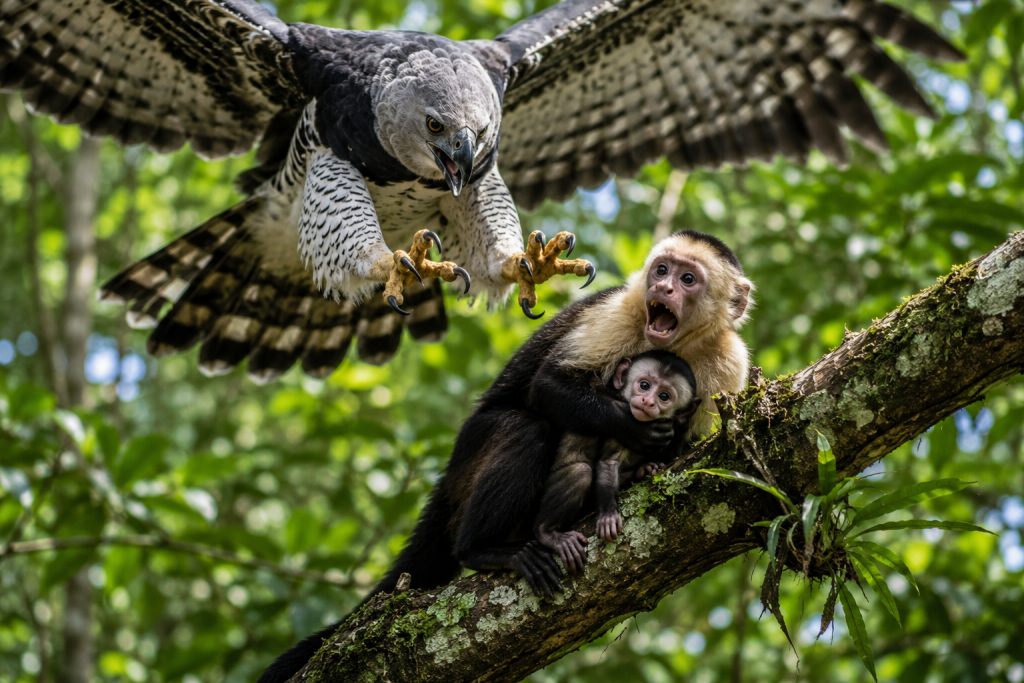
Deep within the rainforests of Central and South America, a shadow crosses the canopy without a sound. Ninety feet below, a troop of white-faced capuchin monkeys forages among the branches, unaware that they are being watched. The Harpy Eagle, one of the largest and most powerful raptors on Earth, has already chosen its target. This is not a chance encounter but the result of millions of years of evolutionary refinement, a finely tuned partnership between predator and habitat. Understanding how the Harpy Eagle hunts, and why it so often targets young capuchin monkeys, reveals something larger than a single dramatic moment in the wild. It exposes the delicate mechanics of an entire ecosystem, where vigilance, cooperation, and adaptation determine which animals survive and which do not. For wildlife enthusiasts and conservationists alike, few predator-prey relationships illustrate the rainforest’s balance of power as vividly as this one.
A Raptor Built for Power
The Harpy Eagle (Harpia harpyja) commands respect the moment it is seen. Adult females can weigh up to 20 pounds and possess a wingspan approaching seven feet, making them among the heaviest eagles in existence. However, their most striking feature lies in their feet. Harpy Eagle talons can grow longer than the claws of a grizzly bear, generating a crushing grip strong enough to instantly incapacitate prey weighing as much as the bird itself. Combined with broad, rounded wings adapted for maneuvering through dense forest canopy rather than open sky, this raptor is built less for soaring and more for stealth and sudden, overwhelming force.

Life in the Canopy: The White-Faced Capuchin
To understand the Harpy Eagle’s hunting behavior, it helps to understand its prey. The white-faced capuchin (Cebus capucinus) is a highly intelligent, socially complex primate found throughout Central American rainforests. Living in troops of ten to thirty individuals, capuchins rely on group cooperation for foraging, defense, and rearing offspring. Their arboreal lifestyle keeps them relatively safe from ground predators such as jaguars and snakes, but it exposes them to a different kind of threat entirely: predators that attack from above. Juvenile capuchins, still developing coordination and judgment, are especially at risk whenever curiosity draws them away from the protective center of the troop.

The Anatomy of an Ambush
Unlike pursuit hunters that chase prey across open terrain, the Harpy Eagle depends almost entirely on stealth and patience. It will perch motionless for hours at a time, scanning the forest below with eyesight estimated to be several times sharper than that of a human. Once it identifies an isolated or distracted individual, typically a juvenile monkey or sloth separated from the safety of numbers, the eagle launches in a rapid, near-silent descent through the canopy. Its wings fold tightly against its body to slip between branches before its talons extend at the final moment of impact. The entire sequence can unfold in seconds, leaving prey almost no opportunity to react.
Why Predators Target the Young
From a purely energetic standpoint, hunting a fully grown adult capuchin carries significant risk. Adults are faster, stronger, and protected by coordinated troop defense. A failed attack can leave a predator injured or exhausted, jeopardizing its own survival. Juveniles, by contrast, offer a more favorable balance between energy expended and caloric reward. This pattern is not unique to Harpy Eagles; lions favor young or weakened wildebeest, and wolves frequently isolate the most vulnerable member of a herd. Such behavior should not be interpreted through a lens of cruelty. It is simply an evolutionary strategy shaped by natural selection, favoring efficiency over unnecessary risk.
How Capuchin Troops Fight Back
Capuchin monkeys are far from defenseless. When an eagle is spotted, sentinel individuals emit sharp alarm calls that travel rapidly through the canopy, alerting the entire troop within moments. These calls are not generic distress signals; researchers studying primate vocalizations have found that many species use distinct alarm calls for aerial versus terrestrial threats, allowing troop members to respond with the appropriate defensive behavior almost instinctively. Mothers react almost instantly, retrieving vulnerable infants and pulling them close against their bodies. Meanwhile, several adults may engage in mobbing behavior, a coordinated display in which multiple monkeys vocalize loudly, shake branches, and lunge toward the predator to discourage further pursuit. This collective response dramatically raises the cost of an attack for the eagle, often forcing it to abandon the hunt altogether rather than risk injury from a determined, multi-directional counterattack. Mobbing behavior, observed across many primate and bird species worldwide, demonstrates how social cooperation can offset individual vulnerability in the animal kingdom, turning a lone infant’s disadvantage into a collective advantage for the troop.
An Apex Predator’s Ecological Role
Beyond the drama of individual hunts, the Harpy Eagle serves a vital ecological function. As an apex predator, it helps regulate populations of monkeys, sloths, and other canopy-dwelling mammals, preventing overpopulation that could strain rainforest food resources. This top-down regulation, often referred to by ecologists as trophic control, contributes directly to biodiversity and forest health. The presence of a stable Harpy Eagle population is frequently used by researchers as an indicator of a thriving, intact ecosystem, since these birds require vast, undisturbed territories to hunt and breed successfully.
Conservation Concerns
Despite its formidable reputation, the Harpy Eagle faces mounting pressure from deforestation across its range. Habitat fragmentation reduces the large tracts of continuous canopy these birds require, since a single breeding pair may need dozens of square miles of intact forest to reliably find prey. Illegal hunting continues to threaten already declining populations in parts of Central America, where local communities sometimes view the eagle as a threat to livestock, despite limited evidence of such predation. Conservation organizations across Panama, Brazil, and Belize have implemented nest-monitoring and reforestation initiatives aimed at protecting breeding pairs, often working alongside local landowners to establish protected corridors between fragmented forest patches. Because Harpy Eagles reproduce slowly, typically raising a single chick every two to three years, population recovery depends heavily on sustained, long-term habitat protection rather than short-term intervention.
Conclusion
The relationship between the Harpy Eagle and the white-faced capuchin monkey offers a window into the broader mechanics of rainforest survival. Every ambush, every alarm call, and every act of maternal protection reflects strategies refined over millennia of coexistence between predator and prey. Rather than a story of violence, it is a story of balance, where vigilance and cooperation on one side meet patience and precision on the other. As deforestation continues to threaten these habitats, protecting the rainforest canopy means protecting both hunter and hunted, preserving an ecological relationship that has shaped Central and South American forests for millions of years.
