
Nature has always been the greatest storyteller. No Hollywood script, no blockbuster thriller, no carefully crafted drama can ever match the raw, unfiltered intensity of what unfolds every single day in the wild. And every once in a while, the natural world delivers a moment so extraordinary, so heart-stopping, that it freezes time itself.
This is one of those moments.
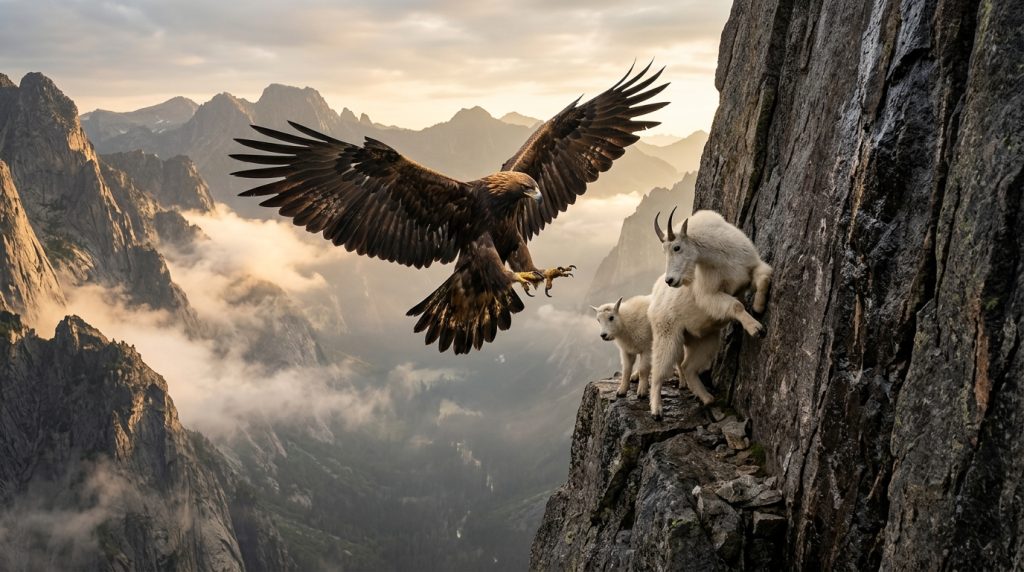
High above a misty mountain valley, where the air is thin and the wind cuts like a blade, two mountain goats cling desperately to a near-vertical rock face. Below them — nothing but a sheer drop into a vast, fog-covered abyss. Above them — no escape. And closing in fast, with wings spread wide and talons locked on target, a golden eagle descends with lethal precision.
What you are about to read is not fiction. It is nature in its purest, most unforgiving form.
A World Few Creatures Dare to Enter
To understand this incredible encounter, you first need to understand the environment where it takes place — a world that most living things simply cannot survive in.
Steep, jagged cliffs rising thousands of meters above sea level. Rocky surfaces with barely enough ledge to rest a single hoof. Winds that can reach over 100 kilometers per hour. Temperatures that plunge below freezing without warning. This is the domain of the mountain goat — a landscape so hostile, so extreme, that it serves as their greatest natural defense against most predators.
Most predators cannot follow them here. Wolves, snow leopards, and bears — as powerful as they are — simply cannot navigate these vertical rock faces. The mountain goat evolved specifically for this terrain, with split hooves that grip like suction cups, muscular legs built for explosive jumping, and a fearless instinct that lets them bound across surfaces that would send any other animal plummeting to its death.
For thousands of years, the cliff was their sanctuary.
Then came the golden eagle.
The Hunter: Nature’s Most Fearless Aerial Predator
The golden eagle (Aquila chrysaetos) is widely regarded as one of the most powerful and skilled hunters in the entire animal kingdom. With a wingspan stretching up to 2.3 meters, razor-sharp talons capable of exerting over 400 pounds of pressure per square inch, and eyesight eight times more powerful than a human’s, this bird was built for one purpose — to hunt.
But what truly sets the golden eagle apart from other birds of prey is not just its physical power. It is its intelligence, patience, and extraordinary courage.
Golden eagles are one of the very few predators in the world that will actively target large mammals — animals that outweigh them many times over. They have been documented hunting rabbits, foxes, young deer, and remarkably, fully grown mountain goats and ibex on cliff faces. Their hunting strategy when targeting cliff-dwelling prey is both calculated and breathtakingly bold.
They do not simply dive and grab. They study. They wait. They position themselves at the perfect angle, using wind currents and sunlight to their advantage, approaching in silence from a blind spot where the prey cannot see them coming. Then, at precisely the right moment, they strike — not always to kill with talons alone, but sometimes to knock the prey off balance, sending it tumbling off the cliff edge.
It is a hunting strategy that requires nerve, precision, and an almost supernatural fearlessness.
The Prey: Mountain Goats Fighting for Every Inch
Mountain goats — and their close relatives, the Alpine ibex — are among the most remarkable climbers on the planet. Watching them scale vertical rock faces is itself a breathtaking experience. Their specialized hooves have a hard outer edge for gripping rock and a soft inner pad for traction, functioning almost like climbing shoes designed by nature itself.
They are not passive animals. When threatened, mountain goats do not simply freeze. They move — fast, agile, unpredictable — using the very terrain that makes their lives dangerous as a weapon against those who would hunt them.
In this encounter, two mountain goats find themselves in an almost impossible situation. They are already on the cliff face, hugging the rock wall with every ounce of strength they have. There is no easy path upward. There is certainly no path downward. And the eagle is already closing the distance with terrifying speed.
Every second counts. Every movement must be precise. One wrong step, one moment of panic, one slip of a hoof — and the cliff does the eagle’s work for it.
The Encounter: When Two Worlds Collide
This is the moment that defines survival of the fittest in its most literal sense.
The eagle arrives with wings spread to their full magnificent span, talons extended, eyes locked on its target with an intensity that is almost impossible to describe. It is not reckless — every detail of its approach has been calculated. The angle, the speed, the timing.
The mountain goats press themselves against the rock. Their instincts are firing at maximum capacity. They sense the shadow before they see the bird. They feel the rush of displaced air before they hear the wings.
What unfolds in the next few seconds is a testament to the incredible adaptability of both predator and prey. The eagle strikes. The goats react. The cliff becomes a stage for one of nature’s most intense performances — a performance where the cost of failure is absolute.
This is not cruelty. This is not violence for its own sake. This is the ancient, unbreakable contract of the natural world. Energy flows from prey to predator. The strong survive. The alert live another day. And the cycle continues as it has for millions of years.
What This Image Teaches Us About the Natural World
Beyond the drama and the adrenaline, this moment captured on camera carries a deeper message — one that we would be wise to pay attention to.
1. Survival is never guaranteed. No matter how well-adapted an animal is to its environment, danger finds a way. The cliff that protects the mountain goat also traps it.
2. Evolution is an arms race. For every adaptation that helps prey survive, predators develop a counter-strategy. The golden eagle did not evolve its courage and hunting intelligence by accident — it evolved because the prey pushed it to.
3. Nature demands respect, not interference. Moments like these are a reminder that the natural world operates on rules far older and more complex than anything human civilization has created. It is not ours to control — only to observe, protect, and deeply respect.
4. Beauty and brutality are two sides of the same coin. This photograph is stunning. It is also terrifying. And that is exactly what makes it one of the most powerful wildlife images ever captured.
The survival battle between a golden eagle and mountain goats on a sheer rocky cliff is more than just a wildlife encounter. It is a window into the soul of the natural world — raw, honest, and utterly magnificent.
In a world increasingly dominated by screens, schedules, and artificial environments, images like this remind us of something essential: life, in its truest form, is a constant, breathtaking fight to exist. Every creature on that cliff face — predator and prey alike — is giving everything it has just to survive one more day.
And in that struggle, there is a kind of beauty that nothing else on Earth can replicate.
