
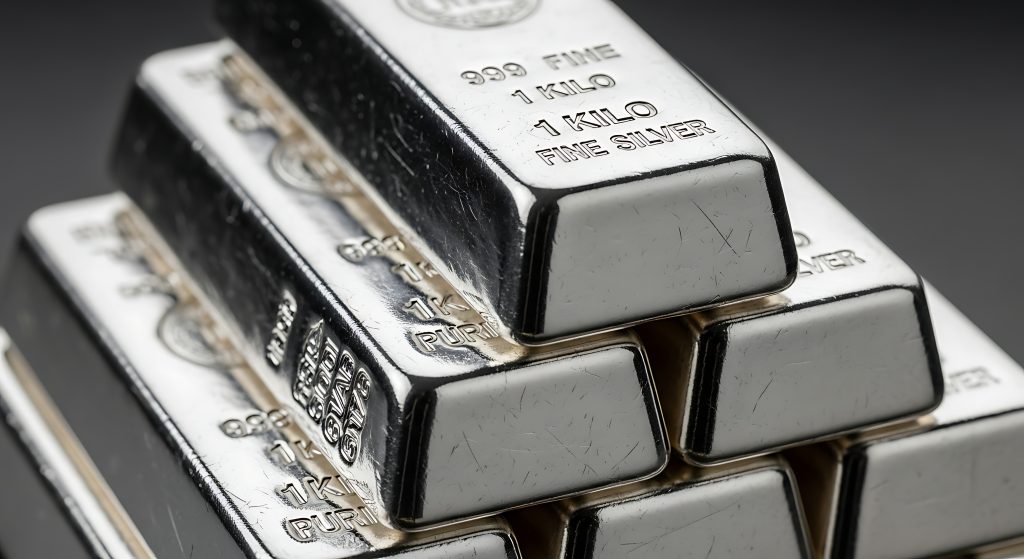
Six consecutive deficits. 762 million ounces drained from above-ground stocks. A liquidity squeeze that briefly sent London lease rates to 200%. The silver market’s structural crisis is no longer a warning. It is the baseline.
Something has been building in the silver market since 2021 that mainstream financial commentary has consistently underpriced. On April 15, the Silver Institute and London-based consultancy Metals Focus released the World Silver Survey 2026, confirming what structural analysts had long suspected: the global silver market is heading into its sixth consecutive annual deficit, with the 2026 shortfall projected at 46.3 million troy ounces up 15% from the 40.3 million ounces recorded in 2025, according to Reuters. For context, the cumulative drain on above-ground inventories since the deficit cycle began now stands at approximately 762 million ounces. That is not a rounding error. It is a structural depletion.
The paradox at the heart of this year’s survey is striking: overall silver demand is actually expected to decline 2% in 2026 to around 1.11 billion ounces, primarily due to price-sensitive categories such as jewellery, silverware, and industrial fabrication. And yet the deficit widens. The reason is equally stark supply is contracting faster than demand. Total global silver supply is forecast to decline by 2% this year as producer hedging normalises after a surge in the second half of 2025. When both demand and supply fall but supply falls faster, the gap expands.

Industrial silver fabrication historically the largest component of demand, covering photovoltaics, electronics, electric vehicles, and medical applications is forecast to decline 2% to approximately 650 million ounces in 2026, a four-year low, per the Silver Institute’s February outlook. The photovoltaic sector, which has become one of silver’s most dynamic growth engines, is still expanding in terms of solar panel installations. However, aggressive silver thrifting by manufacturers reducing the silver content per module is suppressing demand in volume terms.
Jewellery demand is forecast to decline by more than 9% to 178 million ounces, its lowest level since 2020. Silverware contracts even more sharply, down approximately 17%, with India accounting for most of those losses due to the highly price-sensitive, discretionary nature of silverware consumption in that market. Record prices, in other words, are doing what high prices are supposed to do rationing demand and yet the market remains in structural deficit.
The reason lies on the supply side. Mine production is expected to edge up just 1% to approximately 820 million ounces, supported by incremental gains from projects including Hecla Mining’s Keno Hill in Canada and Aya Gold and Silver’s Zgounder mine in Morocco. But new project capacity is not sufficient to compensate for declining ore grades at mature operations across Mexico, Peru, and Bolivia countries that together account for a disproportionate share of primary silver output. The Silver Institute notes that roughly 71% of mined silver is produced as a byproduct of gold, lead, zinc, and copper mines, meaning supply decisions are driven by the economics of other metals, not silver itself.
Against a backdrop of softening industrial and consumer demand, physical investment has emerged as the dominant force shaping the 2026 balance. The Silver Institute projects physical investment demand coins and bars to rise 20% to 227 million ounces, a three-year high. This reversal ends three consecutive annual declines in Western retail investment and marks a decisive reengagement by investors who had been on the sidelines during silver’s extraordinary 2025 price run.
The trigger is well-documented. Silver delivered its strongest annual price performance since 1979 in 2025, surging from under $29 per ounce to a December peak of $84, a gain exceeding 147% for the full year per Reuters. That momentum accelerated into January 2026, when the metal breached the psychologically significant $100 per ounce level for the first time in history, reaching an all-time record of $121.60 per ounce before a hawkish Federal Reserve pivot and escalating conflict in Iran triggered a sharp correction. Silver has since retreated roughly 35% from that peak.
The price performance also compressed the gold-silver ratio to below 50 for the first time since 2012, signalling silver’s significant outperformance relative to its more liquid peer. Global exchange-traded product (ETP) holdings in silver stand at an estimated 1.31 billion ounces, per the Silver Institute’s February report. That stockpile reflects the scale of institutional and retail conviction that silver’s structural tightness is not a temporary dislocation.
The clearest evidence that the deficit cycle had moved from academic concern to market reality arrived in October 2025. A convergence of three forces record inflows into CME warehouses driven by US tariff anxieties, accelerating silver-backed ETP accumulation, and a spike in physical demand from Asia triggered what the World Silver Survey 2026 describes as an unprecedented liquidity stress event in the London benchmark market. Overnight silver lease rates surged to 200%, a level with no modern precedent for a G10-traded commodity.
At the time of the squeeze, non-ETP stocks in London vaults the metal technically available to support spot market liquidity had fallen to record lows. As of the end of March 2026, approximately 28% of the 884 million ounces held in London vaults remained outside ETP structures and were potentially available for market operations, per Reuters. That share has partially recovered since the October episode, but Metals Focus has explicitly warned that conditions for a renewed squeeze remain in place if Indian demand revives and ETP inflows accelerate simultaneously.

The structural mathematics are unforgiving. With 762 million ounces of above-ground inventory drawn down over five deficit years, the buffer the market held at the start of the current cycle has been severely eroded. Each subsequent deficit year reduces the cushion available to absorb demand shocks.
Investment demand is not distributed uniformly. In 2025, the data from the World Silver Survey reveal a pronounced divergence. India recorded a 33% surge in bar and coin demand, driven by a combination of cultural affinity for physical silver, expectations of continued price appreciation, and the rapid growth of domestic silver ETFs holdings of which rose approximately 195% year-on-year between end-2023 and end-2024, per available institutional data. China, meanwhile, recorded a doubling of investment demand, supported by product innovation and the expanding popularity of gold-plated silver jewellery.
As of April 1, 2026, India’s market regulator SEBI implemented reforms allowing domestic mutual funds to allocate to silver ETFs, unlocking a significant new channel for institutional capital flows into the metal. India is already the world’s most silver-intensive consumer market in bullion terms, with silver bullion imports reaching a record 247.4 million ounces in 2024. The SEBI reform adds a structural amplifier to demand that did not previously exist.
The United States presents a more complex picture. For much of 2025, the US market contended with sizable retail investor liquidations, with bar and coin demand falling to a seven-year low of 182 million ounces that year. The 2026 forecast reverses that trajectory: coin and bar demand in the US is expected to recover, contributing to the overall 18% year-on-year increase in global investment demand projected by Metals Focus. The catalyst appears to be a combination of silver’s exceptional price performance, ongoing macroeconomic uncertainty, and concerns over Federal Reserve policy independence — factors that the Silver Institute cites explicitly in its February 2026 outlook.
Silver’s positioning as a hybrid asset simultaneously an industrial commodity and a monetary metal makes its demand dynamics more complex than almost any comparable raw material. It is consumed in solar panels, medical devices, AI data centre cooling systems, and electric vehicle components. It is also held in vaults as a reserve asset and purchased by retail investors as a hedge against currency debasement and financial instability.
The macro environment entering mid-2026 is unambiguously supportive of the monetary component of that demand. The Silver Institute’s February report specifically identifies US tariff concerns, Federal Reserve independence risks, and geopolitical tensions including the Iran conflict as factors sustaining investor interest. The Iran risk carries a dual significance for silver: as a macroeconomic tail risk that drives safe-haven demand, and as a supply-chain variable given the Gulf’s role in global energy and industrial commodity flows. The World Silver Survey 2026 lists the Iran war’s potential drag on global industrial growth as an explicit downside risk to the fabrication demand forecast.
In September 2025, US authorities designated silver as a critical mineral, a classification that carries significant policy implications for strategic stockpiling, domestic production incentives, and supply chain security. That designation is not a minor bureaucratic event. It signals that Washington views silver supply risk as a national security concern a framing that is likely to influence procurement policy, defence industrial base planning, and potentially direct government purchasing.
The 2026 World Silver Survey does not describe a market approaching equilibrium. It describes a market that has now posted six consecutive years of structural deficit, drawn down the equivalent of nearly two-thirds of a billion ounces of buffer inventory, experienced an unprecedented liquidity crisis, seen prices reach all-time records, and is still unable to bring supply and demand into balance.
The forward risk asymmetry is clear. If Indian institutional demand accelerates following the SEBI reform, if ETP inflows resume at 2025 rates, or if geopolitical stress triggers another wave of safe-haven buying, the conditions for a repeat of October 2025’s liquidity squeeze are entirely present. The market does not require a demand surge to face renewed stress it merely requires the continuation of current trends in a system with diminished inventory buffers.
For EU and US investors, the relevant question is not whether silver’s deficit will eventually self-correct – it will, at a price that incentivises sufficient new mine supply and demand destruction. The question is the price at which that correction occurs, and how much above-ground stock remains by the time the market arrives there. On current trajectories, the answer to both questions is likely to be more consequential than financial markets are currently pricing in.
