
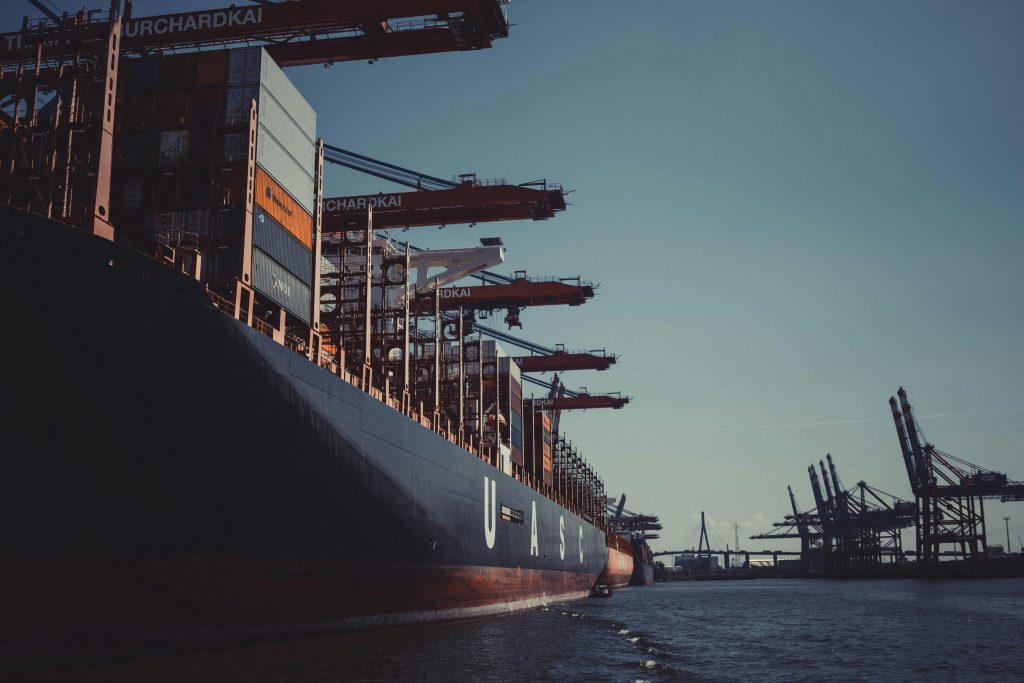
A 33-kilometre strait between Iran and Oman carries one-fifth of the world’s daily oil supply. A Yemeni militia’s drone campaign halved Red Sea oil flows in a single year. These are not footnotes to geopolitical risk — they are the principal transmission channels between conflict and consumer prices. For the EU, whose energy imports flow through every one of these corridors, maritime chokepoints are monetary policy variables.
Sources: EIA, Vortexa, Lloyd’s List, CNBC, Capital Economics, Al Jazeera, Middle East Briefing · Data through March 2026
I. Why a Narrow Strait Can Shake the Global Economy
Nearly 80–90% of global trade moves by sea. What makes maritime chokepoints categorically different from any other supply chain variable is their irreplaceability: there is no quick alternative. A semiconductor factory can be duplicated. A 33-kilometre strait cannot. When geopolitical risk rises in one of these corridors, oil markets price the disruption before a single barrel is diverted — futures rise, war-risk insurance spikes, freight rates surge. The inflationary impulse transmits within days, not months. Iran does not need to close the Strait of Hormuz to move oil markets. It needs only to make commercial operators believe it might.
“Closure of Hormuz would disrupt roughly a fifth of globally traded oil overnight. Prices wouldn’t just spike — they would gap violently upward on fear alone, tightening financial conditions and pushing fragile economies toward recession within weeks.”
— Ali Vaez, Director, Iran Project, International Crisis Group — Al Jazeera, March 2026
II. The Four Critical Chokepoints: By the Numbers
Strait of Hormuz — The Non-Negotiable Corridor
In 2023, oil flows through Hormuz averaged 20.9 million barrels per day (b/d) — approximately 20% of global petroleum liquids consumption (EIA). The strait carried one-fifth of global LNG trade in 2023. Saudi Arabia alone transited 5.5 million b/d in 2024, representing 38% of total crude flows (Vortexa). The absence of viable alternatives is the defining risk: if Hormuz were blocked, bypass pipelines could reroute only 2.6 million b/d — just 13% of normal volume (EIA). Saudi Aramco’s East-West Pipeline was already near capacity in 2024 due to Red Sea diversions. Iran’s Goreh-Jask bypass handled just 70,000 b/d before shutting down in late 2024.
Bab el-Mandeb and the Red Sea — The Houthi Variable
Oil flows through Bab el-Mandeb averaged 8.7 million b/d in full-year 2023. Following Houthi attacks from November 2023, flows collapsed to 4.0 million b/d through August 2024 — a decline exceeding 50% in under a year (EIA/Vortexa). Vessels rerouted around Africa’s Cape of Good Hope, adding 10–14 transit days and proportionally higher fuel and insurance costs. A non-state actor with limited resources had functionally halved flows through a major international corridor.
Suez Canal — Europe’s Core Supply Artery
The Suez Canal handles approximately 10–12% of global trade, serving as the primary artery connecting Asian manufacturing to EU markets. The 2021 Ever Given grounding — six days — disrupted an estimated $9.6 billion in daily trade. In March 2026, CMA CGM suspended all Suez transits following Houthi escalation, rerouting vessels to the Cape of Good Hope. The impact on EU import costs is direct and structural.
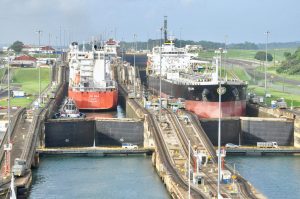
Panama Canal — Climate Risk as Chokepoint
Drought conditions in 2023–2024 forced the Panama Canal Authority to cut daily vessel transits from 38 to 24 — a 37% capacity reduction. This added to global freight rate pressure and illustrates that climate risk has become a structural chokepoint factor alongside geopolitical risk, affecting EU refined product costs indirectly.
III. The Inflation Transmission Mechanism
The pathway from maritime disruption to consumer price inflation is consistent and well-documented. The sequence: oil risk premium priced into futures before physical disruption occurs → war-risk insurance premiums spike (Lloyd’s effectively withdrew Persian Gulf coverage as of 5 March 2026) → freight rates surge on rerouted journeys (Cape routing absorbs ~2.5 million TEU of global container capacity, Middle East Briefing) → energy-intensive EU production costs rise across chemicals, machinery, food processing → consumer prices climb. Central banks face a supply-side shock that rate tools cannot directly address without collateral growth damage.
As Capital Economics economist Hamad Hussain stated in March 2026: a sustained oil price rise would add meaningful upward pressure to global inflation, forcing central banks to choose between holding rates higher for longer or accepting above-target inflation. The ECB’s structural weakness is precisely this: it cannot produce oil, reduce tanker premiums or reroute vessels. It responds only after the impulse has transmitted into the real economy.
🚢 Hormuz transit drop: 81% week-on-week as of 1 March 2026 (Lloyd’s List Intelligence)
⛽ Red Sea oil flow decline: 8.7 mb/d → 4.0 mb/d (Nov 2023–Aug 2024), -54% (EIA / Vortexa)
📦 Ever Given disruption cost: ~$9.6 billion per day in trade, for 6 days (Lloyd’s List, 2021)
IV. Why Europe Is Structurally More Exposed
| Factor | EU | United States | Asia (JP/KR) |
| Oil import dependency | High (85%+ crude) | Moderate (domestic shale) | Near-total (~95%) |
| Hormuz exposure | Significant (via re-pricing) | Low (~2% consumption, EIA) | Critical (69% of flows) |
| Suez/Red Sea reliance | Very High | Moderate | High |
| Energy inflation sensitivity | High (pass-through) | Moderate | High |
| Strategic reserves | Coordinated IEA/EU | Largest SPR (~700mb) | Limited, country-specific |
Sources: EIA 2024; European Commission / Eurostat 2024; IEA. US Gulf crude imports ~0.5mb/d = ~2% of petroleum consumption.
While Asian economies — Japan, South Korea — face the most acute physical supply exposure (84% of Hormuz crude flows went to Asia in 2024, EIA), Europe faces a compounding vulnerability: significant import dependency combined with an energy-intensive industrial structure that amplifies inflation pass-through. Germany, Italy and France — the EU’s largest industrial economies — have cost structures in which energy prices feed directly into manufacturing export competitiveness. ECB research consistently documents that energy price shocks generate faster and larger inflation responses in the euro area than in the US, where domestic shale provides a price buffer that Europe structurally lacks.
V. Three Scenarios for EU Markets in 2026
Scenario A: Short-Term Spike, Swift Resolution
Diplomatic de-escalation restores shipping confidence within weeks. Brent stabilises below $90/barrel. EU headline inflation rises 0.3–0.5 percentage points temporarily. ECB holds rates. Historical precedent: the June 2025 Israel-Iran confrontation, where oil rose $5/barrel briefly before normalising (Middle East Briefing).
Scenario B: Prolonged Risk Environment — Base Case
Shipping operators maintain Cape of Good Hope routing for 6–12 weeks. Freight rates remain elevated; EU energy inflation rises 1–2 percentage points above baseline. ECB faces renewed stagflationary pressure — slowing growth, inflation above target. This is the scenario Barclays and Goldman Sachs are currently pricing as base case (March 2026).
Scenario C: Full Hormuz Closure for 30+ Days
At 20 million b/d, Hormuz carries ~500 million barrels per month. No alternative routing replaces more than 13%. Oil could move toward $100–$120/barrel; EU HICP energy component adds 2–4 percentage points. ECB faces genuine stagflation from an external supply shock. IEA-coordinated SPR releases would provide partial, time-limited relief — as in 2022 following the Russia shock.
VI. Key Indicators for EU Investors
- Brent crude spot and 3-month futures: Sustained move above $90/barrel with backwardation signals physical supply constraint, not only risk premium.
- War-risk insurance premium for Persian Gulf: Lloyd’s Joint War Committee zone designations. Premium spikes to 1%+ of hull value signal commercial shipping will not resume at normal volumes.
- Tanker AIS tracking — Hormuz and Bab el-Mandeb: Real-time vessel traffic (Vortexa, MarineTraffic) gives daily disruption magnitude. Current: Hormuz transits down 81% as of 1 March 2026.
- Baltic Dirty Tanker Index (BDTI): Leading indicator of tanker freight rate movements — rises before consumer price responses.
- EU HICP energy component: Direct consumer-level transmission measure. ECB staff use this to assess second-round effects on core and services inflation.
Conclusion: The Next Inflation Shock May Begin With a Strait
Maritime chokepoints are priced into oil futures every trading day. They are embedded in insurance premiums, freight contracts and procurement budgets across the EU industrial base. The events of late February and early March 2026 — the most acute Hormuz crisis since the tanker wars of the 1980s — have confirmed once again that the global energy system’s most critical vulnerabilities are not in production fields or refineries. They are in 33-kilometre straits that cannot be duplicated, rerouted or replaced.
For EU investors and policymakers, that insight carries direct portfolio implications. Supply risk is inflation risk. Inflation risk is monetary policy risk. And monetary policy risk — when it originates in a strait that the ECB cannot influence — is the most structurally challenging kind.
“It doesn’t take a war. It only takes transport risk.”
— Maritime risk axiom — being tested in real time, March 2026
