
A wildlife biologist’s field notes on the brutal, brilliant war for survival between Africa’s two great predators
The afternoon sun stretches long shadows across the grass. A lioness lies in the shade, her cubs tumbling and wrestling at her feet. It looks like peace. It is a lie. Beyond the tree line, a clan of spotted hyenas has already caught the scent of something far more valuable than meat, vulnerability. In minutes, the stillness will shatter into a standoff where the line between life and death is thinner than a held breath.
Few rivalries in the natural world are as relentless, as ancient, or as savage as the one between lions and hyenas. This is not a story of hatred. It is a story of two apex predators locked in an unforgiving equation: the same prey, the same territory, and the same desperate need to protect their young from one another. To understand why they collide again and again is to understand something far larger, how competition, adaptation, and raw instinct shape survival at the very top of the food chain.
The Savannah: A Battlefield of Extremes
The African savannah offers no mercy. Rain falls in short, unpredictable bursts, forcing herds of zebra, wildebeest, and gazelle to sweep across vast distances chasing water and grass. Predators have no choice but to follow, and because lions and hyenas depend on the same shrinking pool of prey, their territories collide constantly. There is no safe boundary here. Only tension, held in check.
During the dry season, as waterholes shrink and prey becomes concentrated in smaller and smaller pockets, that tension detonates. This is when confrontations between lions and hyenas turn most frequent, most vicious, and most dangerous for the weakest members of either side: the cubs.
Portrait of Two Rulers
The Lion (Panthera leo), Queen of Coordinated Power
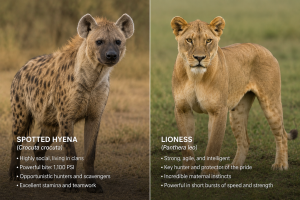
Lions are Africa’s only truly social big cat, living in prides built around related females, their cubs, and a small coalition of dominant males. Adult lionesses weigh 120 to 180 kilograms, built not for endurance but for explosive, close range devastation.
Hunting falls almost entirely to the lionesses. Working as a unit, they compensate for what they lack in raw speed and stamina with coordinated ambush and brute force. As an apex predator and keystone species, the lion’s presence keeps herbivore populations in check, protecting the very grasslands that sustain the entire ecosystem.
But beyond the hunt lies a fiercer duty: defending the cubs, who remain agonizingly vulnerable for their first one to two years of life, a window during which every shadow on the horizon could mean death.
The Spotted Hyena (Crocuta crocuta), The Predator the World Misunderstood
Forget the scavenger stereotype. The truth is far more dangerous: most of a hyena’s diet comes from prey it kills itself. These are hunters first, opportunists second, and chillingly effective at both.
Physically, hyenas are built for a different kind of war. Leaner than lions, with powerful shoulders and a bite force of roughly 1,100 pounds per square inch, among the strongest of any land mammal, they can crush bone and extract nutrition no other predator can reach.
Hyenas live in matriarchal clans that can number in the dozens, governed by a rigid social hierarchy. Their intelligence and coordination, once thought to be the exclusive domain of primates, allow an entire clan to communicate, strategize, and strike as a single, terrifying unit.
Why the War Never Ends
The fight for food is the most immediate trigger. A fresh kill represents hours of concentrated energy that neither species can afford to lose. Hyenas relentlessly attempt to steal, “kleptoparasitize,” a lion’s kill, while lion prides just as often storm in to drive hyenas off a carcass by force.
Territorial disputes deepen the wound. Water, denning grounds, hunting corridors, these are finite resources both species desperately need, and every overlapping range becomes a flashpoint waiting to ignite.
Protecting the next generation is the deadliest layer of all. Lion cubs represent future rivals to hyenas; hyena pups represent the same threat in reverse. Each species will target the other’s vulnerable young whenever the opportunity arises and the risk is low, not out of cruelty, but out of a cold evolutionary logic: eliminating a rival’s future numbers strengthens your own bloodline’s odds of survival.
Drought, scarcity, and rising population density only pour fuel on a fire that never fully goes out.
The Standoff: One Mother Against the Clan
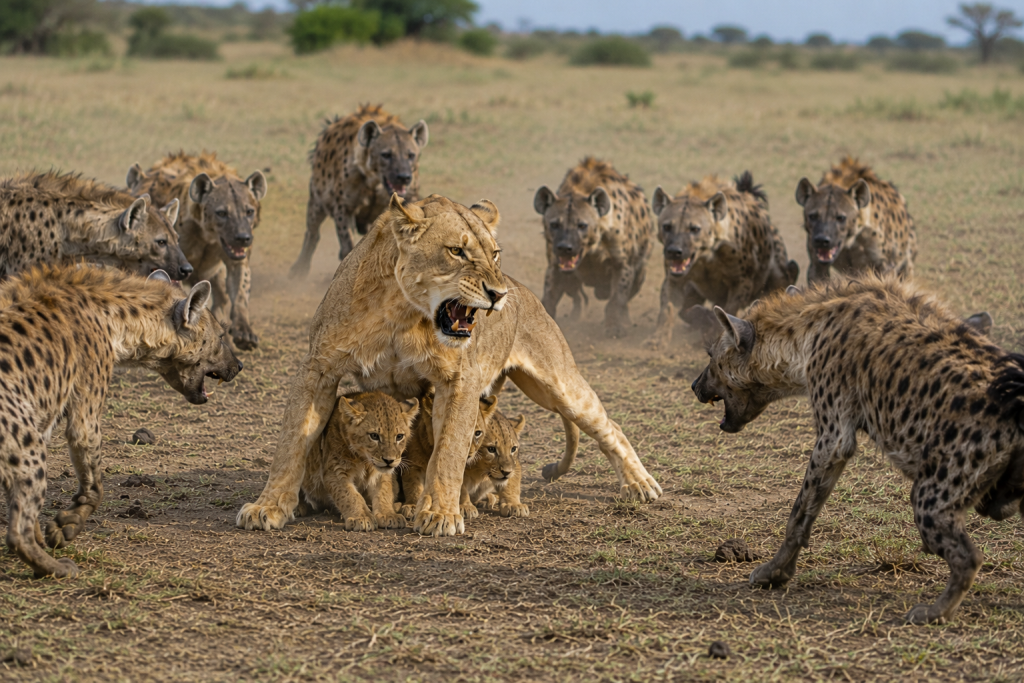
The hyenas close in. The cubs scramble behind their mother, instinct screaming at them to hide. The lioness reads the threat in an instant, ears flattened, muscles coiled, eyes locked on the nearest hyena, and plants herself as a living wall between her cubs and the advancing clan.
The hyenas don’t charge head on. They begin to circle, probing from multiple angles at once, a calculated, merciless tactic designed to split her attention and expose a single fatal gap in her defense.
The lioness answers with a deep, rolling roar that seems to shake the dust off the ground itself. The clan hesitates. But hunger and numbers push several hyenas forward again. The instant one strays too close, the lioness detonates into a short, violent charge, scattering it back into the pack.
Advance. Roar. Charge. Retreat. The cycle repeats, again and again, as dust rises in thick clouds around the standoff. Not once does the lioness abandon her position between her cubs and the clan, even as she stands hopelessly outnumbered. Eventually, with no clean opening and the risk of serious injury mounting, the hyenas break off and melt away, searching for easier prey elsewhere.
What This Fight Reveals
This confrontation lays bare a deeper truth about evolution. Lions evolved toward raw strength and close range power. Hyenas evolved toward social intelligence and coordinated strategy. Neither path is superior, each is a different answer to the same brutal question of survival.
Strength alone guarantees nothing. Isolation and being badly outnumbered can neutralize even nature’s most powerful predator, while teamwork can level the playing field for animals half its size.
And above all, maternal defense emerges as one of the most ferocious forces in the animal kingdom. A lioness’s willingness to stand alone against an entire clan reveals a hard evolutionary truth: her own survival matters less, in the arithmetic of nature, than the survival of the bloodline she is fighting to protect.
The Conservation Stakes
Lions are currently classified as Vulnerable by the IUCN, their numbers falling steadily due to habitat loss, human wildlife conflict, and dwindling prey populations. Spotted hyenas are listed as Least Concern, though their numbers, too, are declining in some regions, squeezed by habitat fragmentation and retaliatory killings fueled by decades of cultural misunderstanding.
Both predators are ecologically irreplaceable. Lions keep herbivore populations in balance and protect grassland health; hyenas recycle carcasses and limit the spread of disease across the ecosystem. Protecting the wild spaces that allow both to coexist, however violently, is essential to preserving the fragile balance of the entire savannah.
Conclusion
The rivalry between lions and hyenas is not a story of heroes and villains. It is the story of two extraordinary predators, forged by millions of years of evolution, locked in an endless struggle for the same finite resources on one of the harshest landscapes on Earth. Every confrontation, however dramatic, echoes the same primal force: the drive to survive, and the deeper drive to ensure the next generation survives as well.
Out here, nothing is ever guaranteed. But as the lion vs hyena rivalry proves again and again, determination, adaptation, and the fierce instinct to protect one’s own remain among nature’s most enduring, unbreakable strategies.
