
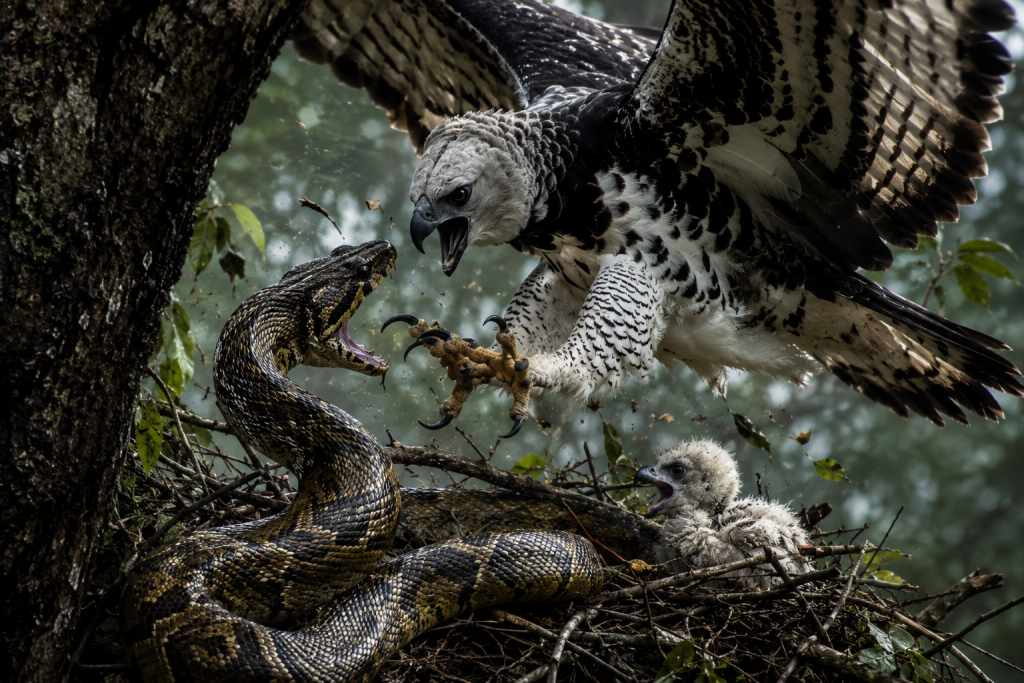
Nearly 130 feet up, in the crown of a giant kapok tree, a young harpy eagle waits for its parents to return with food. Below, a boa constrictor moves with careful precision, drawn upward by the promise of an easy meal.
What follows is a brief but telling collision between two specialized predators one built for stealth and ambush, the other for speed and striking power. Understanding why it happens reveals how nesting birds survive in one of Earth’s most competitive ecosystems.
Life High in the Rainforest Canopy
The tropical rainforests of Central and South America are structured in vertical layers, from the shaded forest floor to the sunlit canopy far above. Each layer supports species adapted to its particular conditions, and the upper canopy has long been considered relatively safe from ground-based predators.
Yet height alone offers no guarantee of safety. Snakes, monkeys, coatis, and other skilled climbers regularly move through the branches, and nest predation is one of the most persistent challenges facing birds throughout the tropics. Even a nest built far above the ground remains within reach of the right predator.
Harpy Eagle (Harpia harpyja)
Widely regarded as one of the most powerful birds of prey on Earth, the harpy eagle inhabits the tropical forests of Central and South America. Females, notably larger than males, can weigh up to 9 kilograms with a wingspan approaching 2 meters.
Its most striking feature is its talons, which can exceed 13 centimeters — longer than the claws of many bears — enabling it to capture substantial prey such as monkeys and sloths directly from the canopy. Because breeding pairs raise only a single chick every two to three years and care for it for over a year after hatching, each nest represents an exceptionally high reproductive investment worth defending.

Boa Constrictor (Boa constrictor)
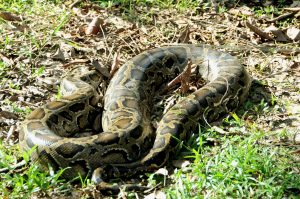
Among the rainforest’s most adaptable predators, boa constrictors can exceed 4 meters in length and climb with surprising skill. Lacking venom, they rely instead on stealth and constriction, using powerful coils to subdue prey after a close ambush.
Their diet is broad, including rodents, birds, bats, and occasionally nestlings, making an unattended nest a potentially rewarding, if risky, target. As opportunistic hunters, boas play an important role in regulating small vertebrate populations throughout their range.
Why Do These Animals Clash?
The underlying driver is energy efficiency. Predators favor opportunities offering high nutritional reward relative to risk, and a nestling represents exactly that kind of opportunity for a large, opportunistic snake.
Eagle chicks are especially vulnerable before fledging, unable to fly or defend themselves independently. For a boa capable of climbing to the nest undetected, the potential reward — enough food for days or weeks — can outweigh the risk, particularly if the adult eagle is absent when the approach begins.
The Encounter
As the boa continues its ascent, blending almost seamlessly with the surrounding bark, the chick grows increasingly agitated, calling out repeatedly across the canopy. Moments later, a shadow crosses the treetops as the mother harpy eagle returns.
She identifies the threat immediately, landing on a nearby branch to assess the situation before launching her attack. Diving with remarkable speed, she strikes at the snake’s body with her talons, aiming to force it away from the nest while avoiding a retaliatory bite.
The boa coils tightly around the branch and raises its head in defense, but its position works against it — a snake mid-climb has far less leverage and mobility than one on solid ground. As the exchange continues, the eagle finds her opening: closing her talons firmly around the snake’s body, she wrenches it free from the branch entirely.
With powerful wingbeats, she carries the boa away from the nest tree and out over the canopy. The threat is not merely driven off — it is physically removed, leaving the chick safe.
Survival Strategies
This exchange highlights two distinct evolutionary strategies rather than a simple mismatch of strength. The harpy eagle relies on exceptional vision, aerial mobility, and powerful talons, striking quickly and repeatedly from advantageous angles.
The boa constrictor depends on camouflage, patience, and raw muscular strength — effective for ambush, but a serious disadvantage when caught mid-climb with limited room to maneuver. Neither strategy is superior in absolute terms; the outcome here hinged largely on timing and position rather than overall power.
What Can We Learn from This Encounter?
This event offers several insights into life in the rainforest canopy. No nest, regardless of height, is entirely free from risk, and specialized predators continue to find ways to exploit vulnerable moments.
It also illustrates the intensity of parental investment in slow-reproducing species. Because harpy eagles raise so few offspring across their lifetime, defending each one aggressively makes strong evolutionary sense. Finally, it shows how a species built primarily as a hunter can shift seamlessly into the role of protector when circumstances demand it.
Conservation Perspective
The harpy eagle is currently classified as Near Threatened, primarily due to deforestation and the loss of the large emergent trees required for nesting. Because each breeding pair produces so few offspring, population recovery after habitat loss can be especially slow.
The boa constrictor remains more widespread but also faces pressure from habitat destruction and, in some regions, the illegal wildlife trade. Protecting large, intact areas of tropical rainforest is essential for sustaining both species and the broader web of predator-prey relationships that depend on a healthy canopy ecosystem.
The confrontation between a boa constrictor and a mother harpy eagle is not a matter of villainy or heroism — it is a clear illustration of risk, opportunity, and parental investment playing out high above the forest floor. For the snake, the nest represented a chance worth taking. For the eagle, it represented something worth defending at any cost, and this time, decisively so: the intruder was carried bodily away from the tree, rather than merely chased off.
In the rainforest canopy, survival depends on more than strength or stealth alone. It depends on timing, adaptability, and — for a mother harpy eagle — an unwavering commitment to protecting the next generation.
