
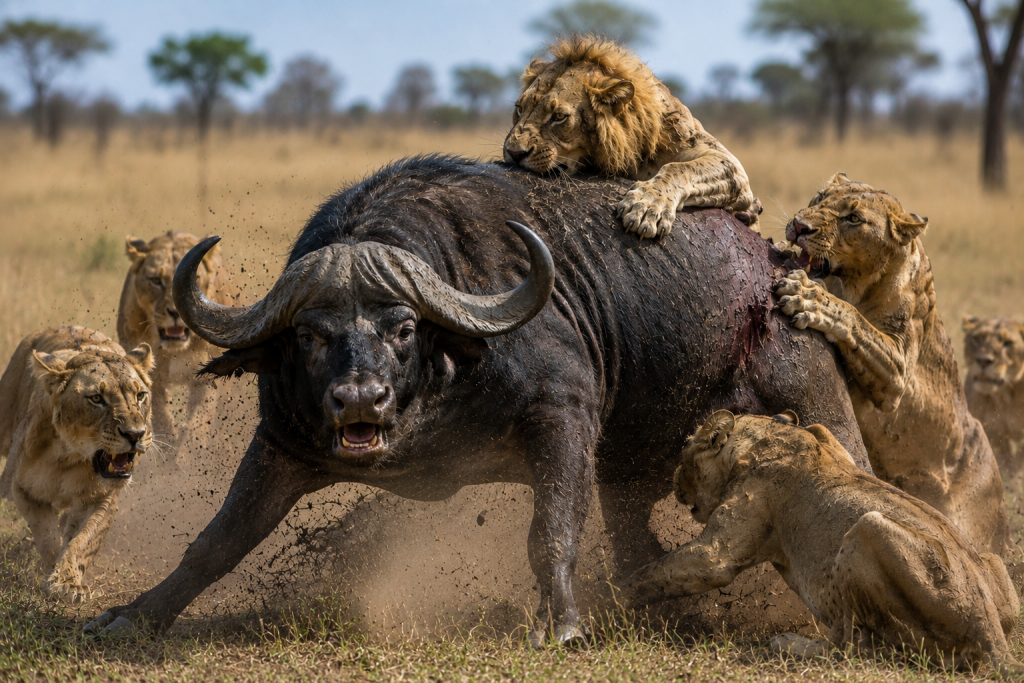
On the African savannah, safety depends on numbers — and one lapse in the herd can change everything.
A lion pride hunting an African buffalo represents one of the most demanding tests of coordination in the natural world, pitting one of Africa’s most social predators against one of its largest and most powerful herbivores. Success is far from guaranteed. It depends almost entirely on one decisive factor: whether the buffalo remains within the safety of the herd.
Life on the African Savannah
The African savannah stretches across vast regions of eastern and southern Africa, supporting an extraordinary diversity of wildlife. Seasonal rainfall governs the availability of water and grazing, forcing herbivores to move constantly across the landscape.
For prey species, survival depends heavily on vigilance and group behavior. Zebras, wildebeest, and buffalo rarely travel alone, since herd living increases the number of eyes and ears available to detect approaching predators. Lions, hyenas, and other carnivores are constantly probing these herds, searching for individuals that are young, injured, or isolated.
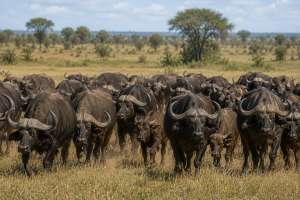
African Buffalo (Syncerus caffer)
Also known as the Cape buffalo, this species is among Africa’s most formidable herbivores. Adult males can weigh more than 800 kilograms and carry heavily reinforced horns fused across the forehead into a protective boss.
Buffalo live in herds ranging from a few dozen to several hundred individuals and are known for cooperative defense herds have been observed charging predators together, sometimes successfully driving off lions attempting to take a calf or injured adult. Strong hearing and tight social bonds allow the group to detect danger early, but these advantages disappear almost entirely once an individual becomes isolated.
Lion (Panthera leo)
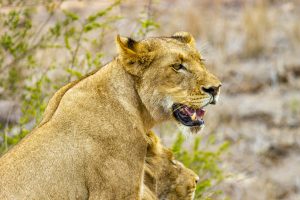
The lion is Africa’s only truly social big cat, living in prides composed of related females, their cubs, and a coalition of males. Lionesses conduct the majority of hunts, relying on teamwork, stealth, and coordinated positioning to take down prey far larger than any individual lion.
A single adult buffalo can feed an entire pride for several days, making it a highly valuable target. However, hunting buffalo is dangerous an adult is powerful enough to seriously injure or kill a lion, so prides carefully weigh risk against potential reward before committing to an attack.
Why Do Lions Target Isolated Buffalo?
A healthy buffalo protected within a herd is an extremely difficult target: multiple adults can surround a predator, charge in defense, and force a retreat. An isolated individual changes this calculation entirely.
Lions consistently favor prey that is old, injured, inexperienced, or alone, since these animals require less energy to subdue and present lower risk of injury. Because every hunt carries an energetic cost, and failed attempts can leave lions vulnerable or exhausted, targeting a vulnerable individual reflects a strategy refined over evolutionary time rather than opportunistic aggression.
The Encounter
As the isolated bull continues toward the herd, unaware of how far he has fallen behind, the lionesses break from cover, approaching from multiple directions at once. The buffalo reacts immediately, lowering his head and charging the nearest attacker.
The first lioness narrowly avoids his horns as he spins to face another approaching from behind. For several moments, he holds his ground, but the lions do not attack from a single direction. While some distract him from the front, others move to his flanks and hindquarters, exploiting the coordination that makes lion hunts so effective against much larger prey.
Repeated charges drain his energy, and as exhaustion sets in, the pride intensifies its effort. Eventually, sheer numbers overcome individual strength, and the hunt reaches its conclusion as evening falls across the grassland.
Survival Strategies
The buffalo’s primary strengths size, horns, and raw power are most effective within a group, where multiple animals can combine their defense. Alone, even an animal capable of seriously injuring a lion cannot defend every angle at once.
The lions’ advantage lies not in individual strength but in coordinated strategy: dividing attention, exploiting blind spots, and sustaining pressure until fatigue creates an opening. This contrast highlights a broader principle in predator-prey dynamics — cooperation can offset a significant disparity in size and power on either side of the encounter.
What Can We Learn from This Encounter?
This event underscores several lessons relevant across the animal kingdom. Group living remains one of the most effective defenses available to prey species, and isolation dramatically increases vulnerability regardless of an individual’s size or strength.
It also demonstrates how cooperation allows predators to overcome challenges no single individual could manage alone. For lions, hunting success depends less on brute force than on communication, positioning, and patience traits shaped by generations of social evolution.
Conservation Perspective
Both species play essential roles in maintaining ecosystem balance. African buffalo influence vegetation patterns through grazing and serve as a critical prey base for large carnivores, while lions help regulate herbivore populations and prevent overgrazing.
According to the International Union for Conservation of Nature, lions are classified as Vulnerable across much of their range, with populations declining due to habitat loss and human-wildlife conflict. African buffalo remain more numerous but face similar pressures from shrinking grasslands and expanding human development. Protecting large, connected wilderness areas is essential to preserving the natural balance between these two species.
The confrontation between a lion pride and an isolated buffalo is not simply a story of predator versus prey it is a demonstration of cooperation, vulnerability, and the constant balancing of risk against opportunity that defines life on the savannah.
For the buffalo, survival depends on the herd. For the lions, survival depends on teamwork. And for every animal navigating Africa’s grasslands, a single decision to stay close or fall behind can determine everything that follows.
