
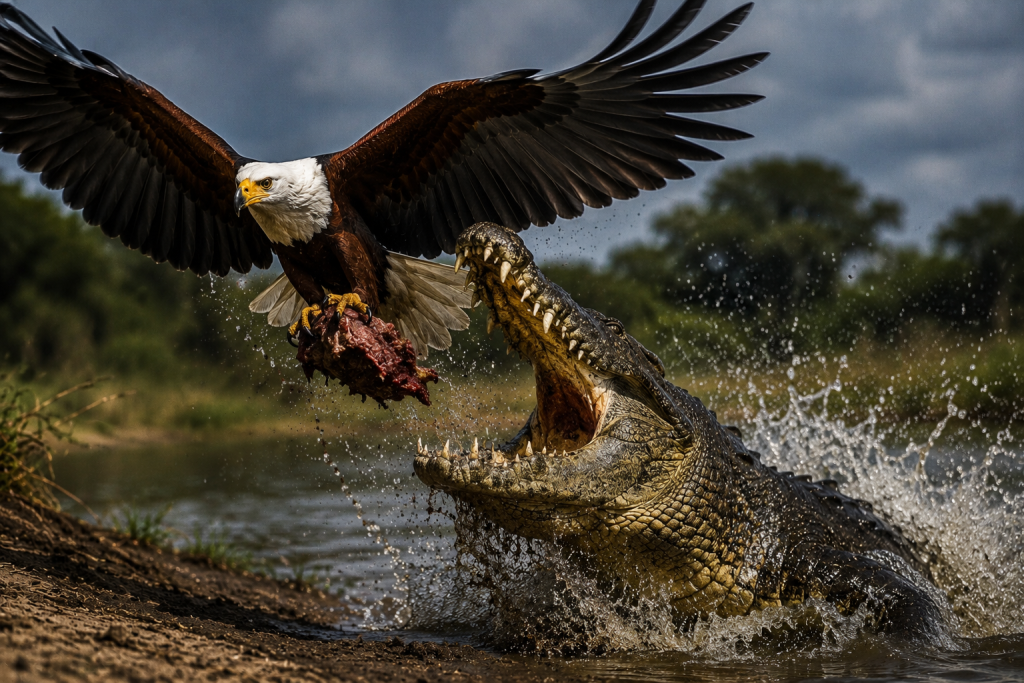
An African fish eagle vs Nile crocodile standoff is one of the more unexpected rivalries on Africa’s waterways, pitting a formidable aerial hunter against one of the most powerful reptiles on Earth. It rarely involves a direct hunt. Instead, it plays out over something both animals value just as highly: a meal already caught.
Picture a Nile crocodile hauling a freshly caught fish onto a muddy sandbar as the afternoon light fades. From a dead acacia overhead, an African fish eagle has been watching the entire sequence, waiting for the precise moment to strike not at the crocodile, but at its catch.
This kind of confrontation, known scientifically as kleptoparasitism, is far from rare in the animal kingdom. Understanding why it happens, and what it reveals about energy, risk, and survival, offers a window into how competition shapes life along Africa’s rivers.
Life Along Africa’s Rivers
Africa’s rivers, lakes, and wetlands from the Nile to the waterways of Botswana and Tanzania — support an extraordinary concentration of wildlife. Fish, birds, reptiles, and mammals all rely on the same limited supply of food and water.
During dry seasons, shrinking water levels compress prey and predators into smaller spaces, intensifying competition. In this environment, a successful hunt rarely goes unnoticed, and every kill can attract scavengers or rivals looking for an easy opportunity.
Species Profile
African Fish Eagle (Haliaeetus vocifer)
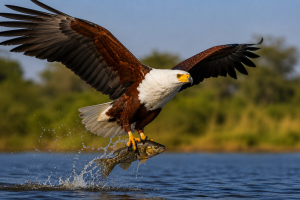
Found throughout sub-Saharan Africa near rivers, lakes, and wetlands, the African fish eagle is instantly recognizable by its white head, chestnut body, and hooked beak. Adults weigh between 2 and 3.6 kilograms modest for a raptor of such reputation.
Exceptional eyesight allows the eagle to spot fish movement from considerable heights, while specialized scales on its talons help it grip slippery prey in flight. Though fish make up most of its diet, the species is highly opportunistic, also taking waterbirds, carrion, and food stolen from other predators. This flexibility is central to its survival and its ecological role as an indicator of wetland health.
Nile Crocodile (Crocodylus niloticus)
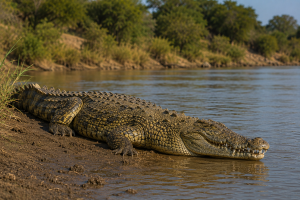
Among Africa’s largest reptiles, adult male Nile crocodiles can exceed 5 meters in length and weigh more than 700 kilograms. They inhabit rivers, lakes, marshes, and estuaries across much of sub-Saharan Africa and have remained dominant aquatic predators for millions of years.
Crocodiles are ambush specialists, capable of remaining motionless for hours before striking with remarkable speed. Their bite force is among the strongest recorded in the animal kingdom, and once prey is seized, escape is extremely difficult. As apex predators, they play a key role in regulating prey populations and cycling nutrients through aquatic ecosystems.
Why Do These Animals Clash?
The underlying driver is competition for a valuable, limited resource: food. A successful hunt represents a significant investment of time and energy, and predators cannot afford to let opportunities go to waste.
For an African fish eagle, stealing an already-captured meal can be more energy-efficient than hunting independently provided the risk pays off. For a Nile crocodile, which may go days or weeks between meals, losing a kill means losing energy needed for growth and reproduction. This is precisely why crocodiles defend food aggressively, and why kleptoparasitism carries real danger for the eagle attempting it.
The Encounter: A Daring Riverbank Theft
Satisfied with its catch, the crocodile begins tearing at the fish, occasionally glancing upward aware, on some level, that it is being watched. Above, the fish eagle waits, tracking every movement from its perch.
The opportunity comes when the crocodile shifts position, briefly loosening its grip on the carcass. The eagle launches immediately, descending fast and low toward the sandbar. For a brief instant, predator and opportunist meet at close range: the crocodile lunges upward as the eagle extends its talons and seizes a portion of the flesh.
The escape is narrow. The crocodile’s jaws close just behind the departing bird, but the eagle clears the water and returns to a nearby tree with its stolen prize. Both animals survive the exchange, and both remain, in the immediate sense, still hungry.
Survival Strategies
The crocodile’s strength lies in raw power and patience, but its low, ground-level position leaves brief windows of vulnerability when guarding a kill. The eagle’s advantage lies in speed, aerial precision, and its ability to strike and withdraw within a fraction of a second a strategy that depends entirely on split-second timing rather than physical dominance.
Neither adaptation guarantees success alone. A miscalculated approach could cost the eagle its life, while a slow reaction could cost the crocodile its meal. The outcome hinges on which species better reads the moment.
What Can We Learn from This Encounter?
This exchange illustrates several principles that extend well beyond these two species. Opportunity favors boldness, but only when paired with precision — reckless risk-taking without accuracy would be fatal. Energy efficiency shapes much of animal behavior, since exploiting another predator’s effort can conserve valuable resources when the risk is manageable.
It also shows that even apex predators are not free from competition; a crocodile’s size and bite force offer no protection against a well-timed aerial raid. Finally, adaptability — the fish eagle’s willingness to shift between hunting and opportunistic theft — offers a clear survival advantage in an unpredictable environment.
Conservation Perspective
Both species remain widespread, with the African fish eagle listed as Least Concern and the Nile crocodile also generally stable, though regional population trends vary. Despite this, both face mounting pressure from habitat destruction, water pollution, overfishing, and expanding human development along Africa’s rivers and wetlands.
Because fish eagles serve as indicators of wetland health and crocodiles help regulate aquatic food webs, protecting these habitats matters for far more than these two species alone — it sustains the broader balance of Africa’s freshwater ecosystems.
The rivalry between the African fish eagle and the Nile crocodile is not a matter of malice or dominance, but a clear demonstration of how opportunity, risk, and energy economics shape behavior in the wild. Along Africa’s waterways, a hard-earned meal is never entirely secure — not even for one of the continent’s most powerful predators.
It is a fitting reminder that survival in nature rarely belongs to the strongest alone. It belongs to those most capable of adapting, timing their moves, and seizing a fleeting opportunity when it appears.
