
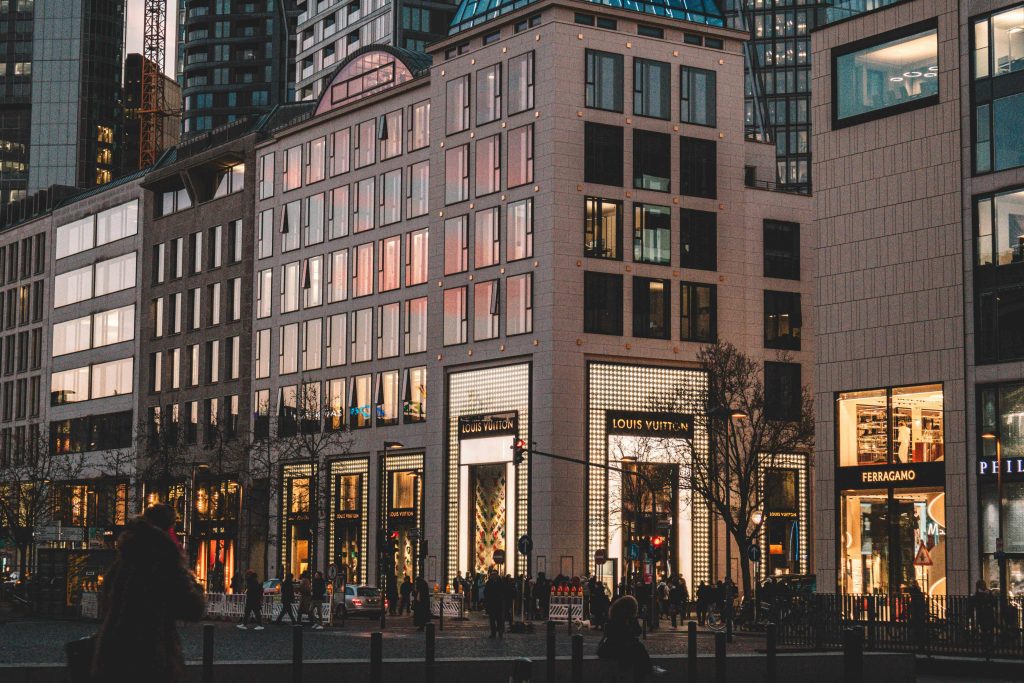
In 1984, Bernard Arnault acquired the bankrupt Boussac textile group for $15 million of his own capital — gaining control of Christian Dior, which he identified as the single asset worth saving. Forty-one years later, LVMH Moët Hennessy Louis Vuitton generates €84.7 billion in annual revenue, employs 211,000 people across 75+ brands, and is the largest company by market capitalisation in the eurozone. The journey from one distressed fashion house to a global luxury empire is inseparable from the personality, tactics, and strategic convictions of the man the industry calls the Wolf in Cashmere.
Sources: LVMH Annual Results 2024 & 2025 | Wikipedia: Bernard Arnault | Britannica: Bernard Arnault | Bloomberg Billionaires Index 2025 | Forbes Billionaires 2025 | Fortune Europe Jan 2025 | CNBC Jan 2025 | Fashion Dive Jan 2025 | Bain & Company Global Luxury Study 2024 | McKinsey Global Fashion Index 2024
The Engineer Who Became the Wolf in Cashmere
Born on 5 March 1949 in Roubaix — a northern French industrial city historically built on textiles — Bernard Arnault grew up in a household shaped by engineering and Catholicism. His mother, Marie-Josèphe Savinel, was a pianist with a deep admiration for Christian Dior; his father ran Ferret-Savinel, a civil engineering firm. Arnault graduated from École Polytechnique in 1971 and joined the family company, quickly steering it toward real estate. But his ambitions exceeded construction. A spell working in the United States introduced him to the mechanics of the leveraged buyout — a then-novel financial instrument that would become the primary tool of his ascent.
The turning point arrived in 1984. The French government was seeking a buyer for Boussac Saint-Frères, a bankrupt textile conglomerate that happened to own the most prestigious name in French fashion. Arnault, working with investment bank Lazard Frères, assembled $80 million in capital, of which only $15 million was his own. He won the bid for what was effectively one franc. After taking control, he sold every Boussac asset except two: Christian Dior and Le Bon Marché department store. He laid off 9,000 workers in two years, earning the first of several nicknames — ‘The Terminator’. By 1987, the company was profitable again, booking $112 million in earnings on $1.9 billion in revenue. The lesson he drew: a heritage brand, properly focused and ruthlessly managed, is a compounding asset unlike any other.
“Money is just a consequence. I always say to my team, don’t worry too much about profitability. If you do your job well, the profitability will come.”
— Bernard Arnault, Chairman and CEO, LVMH
🇦🇺 Boussac acquisition (1984): $15m own capital; total acquisition price ~$80m via Lazard (Wikipedia: Bernard Arnault; Britannica)
📊 LVMH 2024 revenue: €84.7 billion; operating profit €19.6 billion (margin 23.1%) (LVMH Annual Results 2024)
💰 Net worth (Dec 2025): ~$190–203 billion (Forbes / Bloomberg) — sole non-American in global top 10 (Forbes & Bloomberg Billionaires Index 2025)
🏢 LVMH portfolio: 75+ brands; 211,000 employees; 6 business divisions (LVMH Annual Results 2025)
The LVMH Takeover: How Arnault Built the First Luxury Conglomerate
Arnault’s entry into LVMH — created in 1987 from the merger of Moët Hennessy and Louis Vuitton — was an act of strategic aggression disguised as partnership. Initially invited to invest as a stabilising shareholder by LVMH chairman Henri Racamier, Arnault moved swiftly and decisively. In July 1988, he paid $1.6 billion to form a holding company with Guinness that secured 24% of LVMH’s shares. When rumours spread that the Louis Vuitton group was accumulating stock to form a ‘blocking minority,’ Arnault spent a further $600 million to buy an additional 13.5% stake, making himself LVMH’s largest shareholder. By 1989, he was Chairman and CEO.
The boardroom battle that followed was one of the most dramatic in French corporate history. Racamier, who had built Louis Vuitton into a global brand, mounted fierce resistance. The French business press was hostile; Arnault was cast as a hostile raider dismantling an institution. He prevailed through legal manoeuvring, financial firepower, and an early demonstration of the conviction that would define his career: that a conglomerate structure — combining the financial resources of a large group with the creative independence of individual brands — was the only viable long-term model for luxury. Every acquisition since has followed the same logic.
The Arnault Model: Creative Freedom Within Financial Discipline
Arnault’s management philosophy contains a productive tension that most business theorists would consider irreconcilable: absolute insistence on financial discipline coexisting with genuine protection of creative autonomy. The Harvard Business Review has described this as the core of what it calls ‘the Arnault Model.’ Each Maison within LVMH operates independently: its own creative director, its own design atelier, its own brand identity. Arnault does not impose a house style across Louis Vuitton and Dior and Fendi and Céline simultaneously. He imposes standards — of quality, desirability and exclusivity — and holds brand leaders accountable to them.
The creative director decisions are the most visible expression of this philosophy. In 1995, Arnault appointed British designer John Galliano — then unknown in the commercial mainstream — to replace Hubert de Givenchy, one of the most venerated names in Paris couture. Women’s Wear Daily dubbed him ‘the Pope of Fashion.’ He subsequently moved Galliano to Dior and appointed Alexander McQueen to Givenchy. He hired Marc Jacobs to create the first ready-to-wear line in Louis Vuitton’s 130-year history. Each appointment was controversial; each revived declining commercial interest in the Maison. The pattern — using creative risk to regenerate brand desire, without compromising heritage positioning — is still the operating principle at LVMH in 2026.
“The creativity and very high quality of our products, our steadfast commitment to excellence, the agility of our teams and the good geographic balance of our locations underpin the success of LVMH and its Maisons.”
— Bernard Arnault, LVMH Annual Results Statement, January 2025
Key Acquisitions: The Logic of the Empire
| Year | Acquisition / Move | Price / Scale | Strategic Logic |
| 1984 | Boussac / Christian Dior | $15m own capital; $80m total | Heritage brand at distressed price; Dior as platform |
| 1989 | LVMH hostile takeover | $600m to secure majority stake | Control of world’s first luxury conglomerate |
| 1995–97 | Galliano, McQueen, Marc Jacobs | Creative investment, not M&A | Revived three declining houses via designer talent |
| 2001 | Fendi acquisition | ~€800m (50.4% stake) | Italian leather; cross-brand artisan network |
| 2011 | Bulgari acquisition | ~€3.7bn (50.4% stake) | High jewellery; geographic diversification |
| 2021 | Tiffany & Co. acquisition | $15.8bn — largest in luxury history | US market; revenue since quadrupled in high jewellery |
Sources: Wikipedia: Bernard Arnault; Britannica; LVMH Annual Reports; ScrewdownCrown LVMH analysis 2024; Bloomberg.
The Tiffany Test: Largest Acquisition in Luxury History
The $15.8 billion acquisition of Tiffany & Co., completed in January 2021, was the most consequential — and turbulent — deal of Arnault’s career. Agreed in November 2019 at $16.2 billion, the transaction nearly collapsed during the COVID-19 pandemic. LVMH attempted to withdraw in September 2020, citing Tiffany’s mismanagement; Tiffany filed suit; LVMH counter-sued. The resolution — a $400 million reduction to $15.8 billion — was effectively a Arnault negotiating coup. He then installed his 28-year-old son Alexandre as Tiffany’s new CEO.
The subsequent performance validated the acquisition logic entirely. Tiffany’s operating profit doubled within two years. Revenue from high jewellery quadrupled. The Landmark flagship store on New York’s Fifth Avenue — renovated as the first store concept to be relaunched — achieved record-breaking revenue in 2024 and became, by LVMH’s own assessment, the world’s leading luxury retail location. For EU investors, Tiffany represents the clearest real-time demonstration of the LVMH value creation formula: acquire a heritage brand with untapped potential at a distressed or disorganised price, inject creative direction and Maison-standard quality discipline, and allow the brand’s latent desirability to compound.
Three Strategic Challenges in 2025–2026
-
China Demand Contraction
Asia, excluding Japan, fell 12.5% year-on-year for LVMH in 2024. China — which had been LVMH’s highest-growth market for over a decade, driving an estimated 30% of global luxury spending at peak — contracted sharply as the property market crisis eroded consumer confidence and aspirational middle-class spending. McKinsey’s 2024 Global Fashion Index forecast global luxury growth decelerating to 1–3% annually through 2027, with only a third of the luxury sector posting positive growth in 2024 (Bain & Company, 2024). Only Japan, boosted by a weak yen-driven tourist surge (+18% YoY), provided organic growth uplift.
-
The ‘Value Equation’ Problem
Bain & Company’s 2024 luxury study identified a structural shift in consumer sentiment the firm called the ‘value equation’: high-net-worth consumers questioning whether luxury brands deliver sufficient experiential, cultural and craftsmanship value to justify pricing. Fashion & Leather Goods — LVMH’s largest division at €41 billion revenue — posted a 3% decline in 2024 and a 10% profit fall, the first revenue decrease since the pandemic. LVMH’s CFO Jean-Jacques Guiony acknowledged that the group had ‘almost not increased prices in 2024,’ unable to offset rising labour costs in gross margin — a significant departure from the pricing power that defined the post-COVID luxury cycle.
-
Succession and Control Structure
Arnault turned 76 in March 2025. His five children — Antoine, Delphine, Alexandre, Frédéric and Jean — each hold management roles within LVMH Maisons, and collectively hold equal stakes in Groupe Arnault with a 30-year lock-up preventing share sales. In early 2025, Arnault extended his own CEO term, deferring a formal succession. For institutional investors, this creates governance uncertainty in a company where the founding family’s holding company, Christian Dior SE, controls 41% of LVMH with majority voting rights. The structure ensures continuity; it also concentrates strategic authority in a 76-year-old chairman with no publicly articulated succession timeline.
Conclusion: A Compounding Machine Built on Desire
Bernard Arnault did not invent luxury. He invented the financial architecture that makes luxury compounding. From the $15 million Boussac bet in 1984 to the $15.8 billion Tiffany acquisition in 2021, the strategic logic has been consistent: identify heritage brands whose desirability exceeds their management, acquire them at price points that underestimate their long-run value, and apply a model that simultaneously protects creative identity and imposes financial rigour.
LVMH’s 2025 results — €81 billion in revenue, €17.8 billion in operating profit at a 22% margin, €11.3 billion in free cash flow — reflect both the resilience and the structural headwinds of that model. China’s contraction is real. The consumer value equation is shifting. The succession question is unresolved. But the empire Arnault built — 75 Maisons, 211,000 employees, an unmatched portfolio of cultural assets — is structurally positioned to outlast any individual cycle. The Wolf in Cashmere has ensured that.
